
A Call to Transform Higher Education – through Individual Actions
The world has changed. The economy has changed. Technology has changed. The students arriving on our campuses have changed. Yet walk into many college classrooms today and you will find an educational model that would be recognizable to a professor from 1925 – lectures delivered to rows of passive students, learning measured by midterms and finals, success reduced to a grade point average, and graduates released into a world that demands competencies they were never asked to develop.
This is not sustainable. And it is not acceptable.
Yes, we can lament that incoming students arrive less prepared than they once did – that too many struggle with close reading, lack foundational critical thinking skills, and feel uncertain about something as basic as introducing themselves to a stranger and starting a conversation. Three-quarters of college faculty respondents report that their students are now less prepared in critical thinking, problem-solving, and close reading and analysis skills than before the pandemic.1 58% of high school teachers say students showing little to no interest in learning is a major problem in their classroom — compared with half of middle school teachers and 40% of elementary school teachers. Across all grade levels, 47% of teachers overall identify student apathy as a major classroom problem.2
These are real challenges. But they are not excuses. We do not get to choose the students who arrive on our campuses. We do get to determine – through the rigor of our teaching, the intentionality of our design, and the depth of our expectations – who they become when they leave. That is the job. That has always been the job.
Higher education stands at an inflection point more consequential than any in its modern history. According to a 2024 report by the Western Interstate Commission for Higher Education, the number of traditional college-age students peaked in 2025 and will decline steadily for the next 15 years — with 13 percent fewer high school graduates by 2041. Economist Nathan Grawe projects an even steeper drop of 15 percent by 2029 alone.3 According to the Cengage Group’s 2025 Graduate Employability Report, only 30% of 2025 college graduates secured full-time jobs in their field — down from 41% the year prior.4 Meanwhile, AI-powered learning platforms, corporate training programs, and micro-credential providers are offering faster, cheaper, and increasingly credible alternatives to the four-year degree. And fear of AI taking away entry-level white collar jobs is causing even more high school graduates – and their parents – to question the value of a four-year college degree.
If higher education is to survive – and more importantly, if it is to matter – we cannot simply adapt. We must transform. Quickly. Intentionally. And with the courage to abandon what no longer works.
Beyond the GPA: From Grades to Mastery
For decades, we have allowed grades to serve as the primary currency of academic achievement. But grade inflation has rendered that currency nearly worthless. Institutions, and even colleges and departments or individual instructors, fear losing students to easier graders, creating a race to the bottom that rewards compliance over competence. The result? Students who earn high marks but cannot think critically, communicate persuasively, or solve problems under pressure. Nearly two-thirds of employers now rely on skills-based hiring practices, and they are finding that a transcript full of A’s tells them remarkably little about what a graduate can actually do.5
The alternative is clear: competency-based and mastery learning. Instead of allowing competence to vary while time remains fixed – the traditional model where a C-grade simply means partial understanding – we must fix competence at a high standard and allow time to be the variable. In a landmark 1984 paper, educational psychologist Benjamin Bloom found that one-on-one tutoring combined with mastery learning produced outcomes two standard deviations above conventional classroom instruction — meaning the average tutored student outperformed 98% of students in a conventional classroom.6 For decades, we told ourselves that we lack the means to deliver this at scale. We no longer lack the means. We lack only the will.
Key Takeaways from Benjamin Bloom
Stop moving the class forward when students are behind.
Bloom’s core insight is that conventional pacing — covering material on a schedule regardless of whether students have mastered it — is the primary driver of poor outcomes. Restructure courses so that demonstrated mastery of foundational concepts is a prerequisite for advancing, even if that means slowing down or offering alternative pathways.
Build frequent, low-stakes feedback loops into your course design.
The two-sigma gains weren’t magic — they came from students receiving specific, timely information about exactly where their understanding broke down. Short diagnostic checks, formative quizzes with immediate feedback, or structured peer review can approximate this at scale far better than high-stakes midterms and finals.
Reframe the role of the grade.
In Bloom’s model, a failing score is not a final judgment — it’s a diagnosis. Consider adopting specifications grading, contract grading, or revision policies that allow students to demonstrate mastery after targeted corrective work rather than penalizing a single performance.
Explore whether AI tutoring tools can close the scalability gap.
Bloom identified scalability as the central unsolved problem — one-on-one tutoring works, but institutions can’t afford it for every student. Tools like Khan Academy’s Khanmigo and similar AI-assisted platforms are being explicitly designed around Bloom’s framework and are worth piloting in courses where foundational skill-building is the primary goal.
Teaching for the Long Term, Not for the Test
The science of learning has advanced dramatically, yet most of our instructional practices ignore it. We know that durable learning is built through effortful retrieval – pulling information from memory, not looking it up. We know that spaced practice, interleaving, and elaborative interrogation produce far stronger long-term retention than cramming for exams. We know that active learning increases performance by half a standard deviation and reduces failure rates by fifty-five percent. We know that students in active learning environments participate at rates thirteen times higher than in traditional lectures. And yet, the dominant mode of instruction at most institutions remains the fifty-minute lecture, optimized not for how students learn but for how schedules are built.
We must redesign instruction around cognitive science, not administrative convenience. This means segmenting class sessions into focused blocks of ten to fifteen minutes, followed by active processing. It means front-loading metacognitive skills – explicitly teaching students how to learn, how to read deeply, how to regulate their own attention and effort. It means using frequent, low-stakes retrieval practice rather than high-stakes exams that incentivize surface memorization. It means embracing what researchers call “desirable difficulties” – the productive struggle that feels inefficient in the moment but builds the neural architecture of lasting understanding.
As learning scientist Manu Kapur’s research has demonstrated, when students wrestle with paradox and contradiction before receiving frameworks, they develop the interpretive capacities essential for navigating ambiguity – precisely the terrain where no algorithm can operate for them.7
The Twin Pillars: Critical Thinking and Emotional Intelligence
If there is one competency that separates the educated mind from the merely credentialed one, it is critical thinking – the ability to evaluate evidence, challenge assumptions, reason through complexity, and change one’s mind when the evidence demands it. And if there is one competency that separates effective professionals from technically proficient ones, it is emotional intelligence – self-awareness, empathy, the ability to navigate interpersonal dynamics with skill and grace.
Neither of these can be developed through lectures. Neither can be measured by multiple-choice exams. And neither will emerge automatically from a curriculum designed around content coverage.
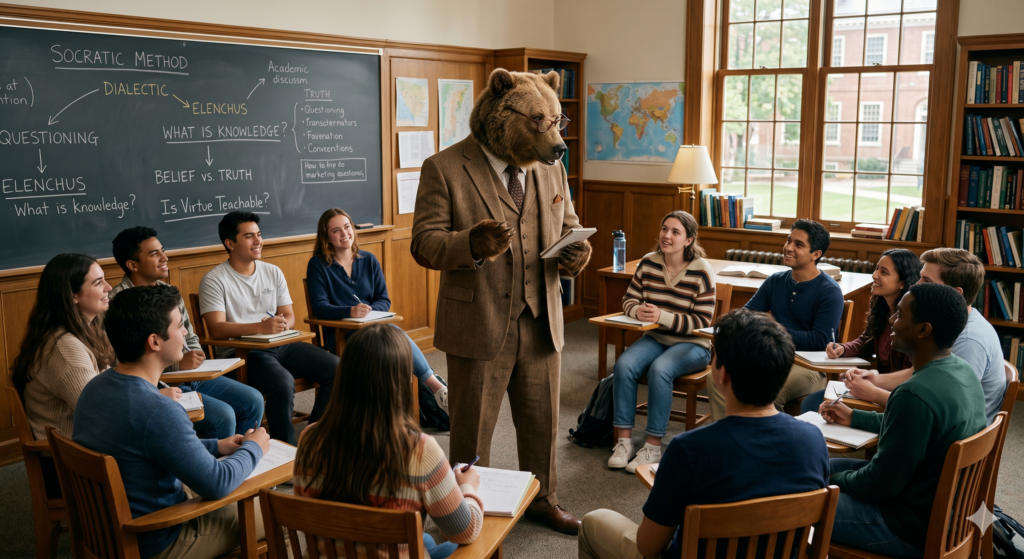
Developing critical thinking requires what one scholar has called “cognitive architecture” – deliberately designed learning environments where students must construct and defend arguments, encounter perspectives that challenge their own, and engage in the kind of Socratic dialogue that has been the hallmark of elite education for centuries. Research shows a significant negative correlation between frequent AI usage and critical thinking scores.8 When students delegate their thinking to technology without reflection, they develop what psychologists call “metacognitive laziness” – they mistake the fluency of AI-assisted performance for genuine mastery. The antidote is not to ban technology but to pair it with rigorous reflection, oral examination, and the expectation that students can defend their ideas in real time, without a script.
Emotional intelligence, meanwhile, develops through the kinds of experiences that industrialized education has systematically eliminated: small-group dialogue, mentorship, collaborative projects that require navigating disagreement, and reflective practice that builds self-awareness. These are not soft additions to a rigorous curriculum. They are the curriculum’s beating heart.
Technology as Catalyst, Not Crutch
We live in a moment of extraordinary technological capability. AI tutoring systems have been shown to produce more than double the learning gains of traditional active learning classrooms, in less time.9 If carefully designed and implemented and monitored, adaptive platforms can diagnose individual misconceptions and provide targeted, Socratic feedback at a scale no human instructor could match.
But technology is a catalyst, not a cure. The evidence is unequivocal: unstructured AI use produces measurable declines in analytical reasoning, argumentative depth, and long-term retention. The same tools that can amplify human cognition can also enable cognitive offloading – the outsourcing of thought itself.
The imperative, then, is not simply to integrate technology across the curriculum but to integrate it wisely. Every student, regardless of major, needs fluency in AI tools, ethics, and human-AI collaboration. But that fluency must be built on a foundation of intellectual ownership – the principle that AI assists thinking but never replaces it. Students must learn to use these tools as reflection partners, not answer machines. They must develop the judgment to know when to lean on technology and when to lean on their own hard-won understanding.
This is not optional enrichment. AI skill sets are evolving much faster than traditional job requirements. We owe our students the preparation to compete – but we also owe them the wisdom to use these powerful tools in service of, not as substitutes for, their own intelligence.
Cultivating Curiosity and the Lifelong Learner
Perhaps the most important outcome of a college education is one that appears on no transcript and is measured by no exam: the disposition toward lifelong learning. In a world where 12 million occupational transitions are projected by 2030 and 39% of existing skillsets will be transformed or outdated in five years, the graduates who will thrive are not those who memorized the most content but those who developed the habit – and the hunger – to keep learning long after commencement.10
Research tells us that only 27% percent of graduates believe college taught them how to frame their own questions.11 That is a damning indictment. If we are not producing graduates who are curious, self-directed, and intrinsically motivated to grow, we are failing at our most fundamental mission – regardless of what their GPAs suggest.
Cultivating this disposition requires intentional design. It means giving students meaningful choices in what they study and how they demonstrate understanding. It means building early success experiences that create confidence, not compliance. It means making thinking visible through reflection, metacognitive prompts, and growth-oriented feedback. It means creating classrooms where the energy is collaborative rather than competitive, where students challenge each other not to win arguments but to sharpen understanding. And it means modeling curiosity ourselves – as faculty, as administrators, as institutions – by embracing experimentation, tolerating productive failure, and demonstrating that learning is not something that happens in a four-year window but across a lifetime.
The Fierce Urgency of Now
Let us be honest about the stakes. Liberal democracy itself depends on citizens capable of critical reading, independent analysis, and sustained engagement with complexity. If universities cannot reliably foster these capacities, we are failing at our most essential social function.
But this is not a counsel of despair. It is a call to action – fierce, urgent, and overdue.
The research is clear. We know what works: mastery learning, active pedagogy, Socratic dialogue (including Oxbridge tutorials), collaborative projects, technology integrated with intention, and assessment that measures what actually matters. We know that the challenges our students face – diminished reading stamina, weakened critical thinking, over-reliance on technology – are not fixed traits but developable capacities. We know that AI, properly deployed, can make elite pedagogy accessible to first-generation students and those from under-resourced backgrounds, narrowing achievement gaps rather than widening them.
What we need now is not merely more research. It is more courage. The courage to abandon the industrial model of education that has persisted for a century. The courage to redesign assessment so that it captures competence, not compliance. The courage to invest in, and transform, ourselves. The courage to tell students that struggle is not the enemy of learning – it is the mechanism of learning.
AI did not break higher education. It revealed how much was already broken – and it has given us, perhaps for the last time, the tools and the imperative to rebuild.
The institutions that will flourish in the decades ahead will not be those with the largest endowments or the most prestigious rankings. They will be those that had the vision to transform – to produce graduates who can think critically, collaborate effectively, adapt continuously, use technology wisely, and never stop learning.
The question is not whether transformation is possible. The question is whether we have the will to begin. Today. Not tomorrow. Not after the next committee report. Now. The future of our students – and of the society they will build – depends on what we do next.
A Call for Individual Action. This Year. Now.
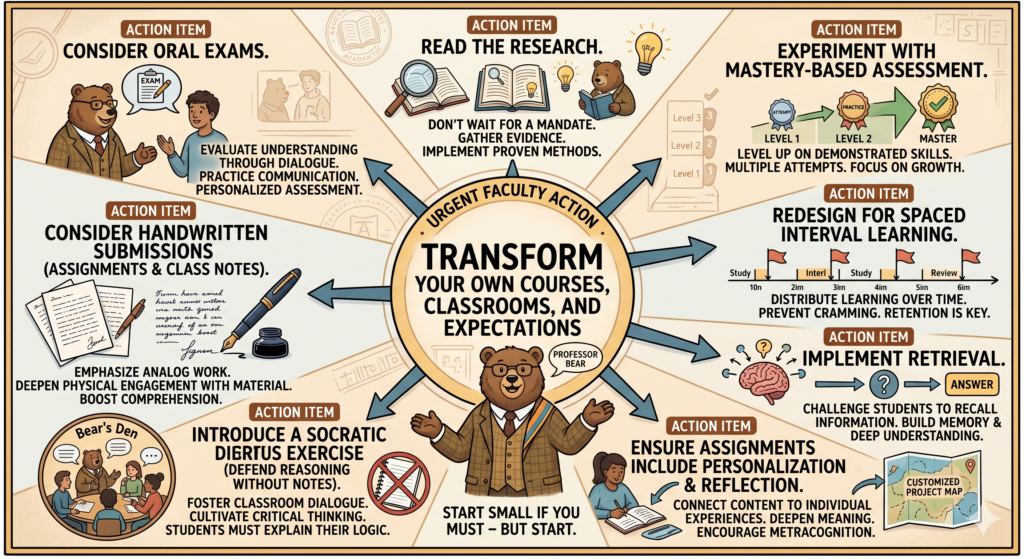
As we approach the summer months, I urge all faculty to take the bull by the horns – and to transform your own courses, your own classrooms, and your own expectations of what students can achieve.
Do not wait for a mandate from the provost or a recommendation from a task force. Read the research. Experiment with mastery-based assessment. Redesign course structure to embrace spaced interval learning and retrieval practice. Ensure assignments include personalization and reflection. Introduce a Socratic exercise where students must defend their reasoning without notes. Consider handwritten submissions of assignments, and submission of handwritten notes from class sessions. Consider oral exams. Build in moments where technology amplifies thinking rather than replaces it. Start small if you must – but start.
This transformation is not the faculty’s alone. Every staff member on campus – from advisors and residence life coordinators to financial aid counselors and the person who swipes student IDs at the dining hall – shapes the student experience in ways that transcend the classroom. Support staff can redesign extracurricular programming to do more than entertain: orientation activities that teach students to introduce themselves confidently to strangers, student organization events structured around collaborative problem-solving rather than passive attendance, and peer mentoring programs that build the emotional intelligence no textbook can teach.
But it starts with something even simpler than programming. It starts with a smile, a greeting by name, a genuine question about how a student’s semester is going. Students learn how to engage with the world by watching how the world engages with them. When every adult on campus models warmth, curiosity, and authentic human connection, we are teaching – whether we hold a faculty title or not.
Transformation does not begin with strategic plans. It begins with individual acts of courage by faculty and staff who refuse to teach the way they were taught, and to guide students as they did in the past, simply because it is familiar. It begins with the professor who decides, today, that competence matters more than compliance – and that every student who walks out of her classroom will carry something more durable than a grade. It begins with a staff member who decides to elevate his or her guidance and interactions to a higher level.
The students are waiting. The world is waiting. Let us not make them wait any longer.
We can do this. Each and every one of us, individually.
Footnotes
- Recent Trends in College Readiness and Subsequent College Performance, College Board Research, July 25, 2024. Full report: https://research.collegeboard.org/reports/college-access/recent-trends-college-readiness ↩︎
- Challenges Public K–12 Teachers Deal With in the Classroom, Pew Research Center, April 4, 2024. https://www.pewresearch.org/social-trends/2024/04/04/challenges-in-the-classroom/ ↩︎
- Western Interstate Commission for Higher Education. Knocking at the College Door: Projections of High School Graduates. December 2024. https://www.wiche.edu/resources/knocking-at-the-college-door/ and Grawe, Nathan D. Demographics and the Demand for Higher Education. Johns Hopkins University Press, 2018. (As cited in the Association of Governing Boards, “Impacts of the Enrollment Cliff in 2025–2026,” July 2025. https://agb.org/blog-post/impacts-of-the-enrollment-cliff-in-2025-2026/) ↩︎
- Cengage Group. 2025 Graduate Employability Report. Cengage Group Blog, 2025. https://blog.cengage.com/2025-graduate-employability-report-closing-career-readiness-gaps/ ↩︎
- National Association of Colleges and Employers (NACE). Job Outlook 2025 Spring Update. May 2025. https://www.naceweb.org/job-market/trends-and-predictions/almost-two-thirds-of-employers-use-skills-based-hiring-to-help-identify-job-candidates ↩︎
- Bloom, Benjamin S. “The 2 Sigma Problem: The Search for Methods of Group Instruction as Effective as One-to-One Tutoring.” Educational Researcher, vol. 13, no. 6, 1984, pp. 4–16. ↩︎
- Sinha, T., & Kapur, M. (2021). “When Problem Solving Followed by Instruction Works: Evidence for Productive Failure.” Review of Educational Research, 91(5), 761–798. ↩︎
- Gerlich, M. (2025). “AI Tools in Society: Impacts on Cognitive Offloading and the Future of Critical Thinking.” Societies, 15(1), 6. https://www.mdpi.com/2075-4698/15/1/6 ↩︎
- Kestin, G., Miller, K., Klales, A., Milbourne, T., & Ponti, G. (2025). “AI tutoring outperforms in-class active learning: an RCT introducing a novel research-based design in an authentic educational setting.” Scientific Reports, 15, 17458. https://www.nature.com/articles/s41598-025-97652-6 ↩︎
- McKinsey Global Institute. Generative AI and the Future of Work in America. July 2023. https://www.mckinsey.com/mgi/our-research/generative-ai-and-the-future-of-work-in-america and World Economic Forum. Future of Jobs Report 2025. January 2025. https://www.weforum.org/publications/the-future-of-jobs-report-2025/ ↩︎
- Head, Alison J. Staying Smart: How Today’s Graduates Continue to Learn Once They Complete College. Project Information Literacy, January 5, 2016. https://projectinfolit.org/publications/staying-smart/ ↩︎