
As another semester enters its final stage, I find myself captivated by the profound transformations unfolding among my 140 freshmen students. Each autumn ushers a new wave of eighteen-year-olds through my classroom door, their faces illuminated by that distinctive blend of trepidation and anticipation. This year stands apart – not for dramatic revelations or sweeping changes, but for the subtle, powerful metamorphoses that have shaped these young minds into more reflective, tenacious scholars and human beings.
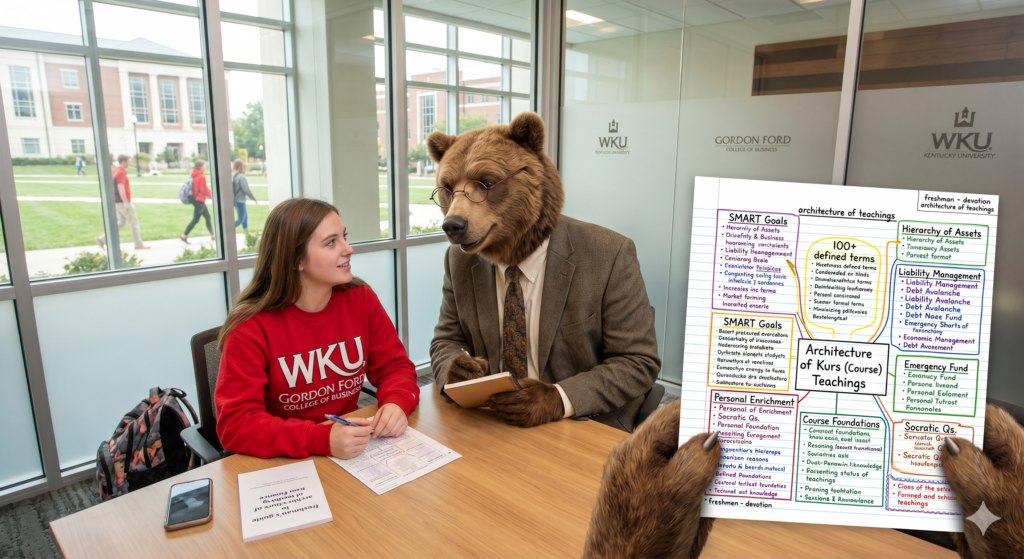
One afternoon, I encountered a student whose academic intensity both inspired and humbled me. She sat in one of the glass-walled Huddle Rooms in Chandler Hall – the gleaming new home of the Gordon Ford College of Business at Western Kentucky University – completely absorbed in what revealed itself to be an extraordinary feat of scholarly preparation. With evident pride, she showed me her masterful handwritten notes page (permitted to be utilized in the exam), which she had transformed into a comprehensive atlas of knowledge, bearing over 100 meticulously defined terms. Nine distinct sections carved the single page into territories of understanding, each illuminated by different colored inks and strategic highlighting. Connecting lines traced intellectual pathways between concepts, creating a visual symphony of comprehension. Her devotion transcended mere memorization – here was a freshman determined to grasp the very architecture of the course’s teachings in personal finance.
Yet even more compelling was witnessing another student navigate the treacherous waters of his first genuine academic failure. This young man arrived bearing the laurels of small-town success. I learned later that his primary and secondary school experience was unmarred by anything below a “B” on any test or exam. When our first exam returned bearing a stark 64%, I observed him traverse the familiar landscape of denial, anger, and despair. The democratic brutality of college competition – where yesterday’s top high school student becomes today’s struggling freshman – had struck without warning.
But then came the transformation that defines character. Rather than retreating into excuses or self-pity, he sought my guidance. With his own determination he then embraced tutoring, revolutionized his study methods, and implemented the Feynman technique alongside spaced interval learning and retrieval practice – various learning strategies we had explored during our opening week. He triumphed on the second exam. He had forged resilience and gained the confidence that comes from confronting failure and emerging stronger.
This semester has revealed another awakening: students deliberately reclaiming their lives from digital tyranny. One student’s discussion board revelation resonates:
“Turning off my phone for an entire day made me feel surprisingly calm and clear-minded.”
Another’s confession cuts deeper: “For two days straight, I stayed off all social media. No scrolling, no notifications… When I finally opened my apps again, everything felt loud and overwhelming. That’s when I realized how much time and energy social media takes up.”
Perhaps most poignant was this admission:
“I deleted both Snapchat and TikTok for a day… I didn’t realize how much time of my day I wasted just watching stupid videos. I kept pulling my phone out to get on there without realizing I had deleted it. This showed me that I have a problem with it and acknowledging it is the first step.”
I am hopeful that these experiences are not just temporary digital detoxes, but hopefully help these students to tackle their often-destructive relationship with the very technology that has so heavily influenced so many students’ development thus far.
Distance has cultivated something beautiful in these freshmen – genuine gratitude. When I challenged students to reach out to family members, the responses transcended obligation. One young woman’s reflection captures this awakening:
“I told my parents I was thankful for everything that they do to contribute to the person that I am and the person that I am becoming. They told me that they loved me and that all they want from me is to stay motivated when it comes to school. I can do that for my parents in return for everything they do for me. This assignment was a nice opportunity to stand still for a moment and take in all that I have to be thankful for, and also to be reminded how much my support system loves me.”
These individual narratives interweave to create a tapestry of contemporary coming-of-age. My freshmen are not merely absorbing course content; they are discovering how to become better lifelong learners – cultivating curiosity, forging friendships, practicing gratitude, and evolving into conscious, engaged citizens. They are learning that authentic success transcends academic scores – and that the development of those important personal skills requires self-control and grit, as well as continuously working on developing good habits and shedding bad habits.
They increasingly recognize that meaningful connection requires full presence in both the classroom, as well as in face-to-face conversations with others. They are experiencing how gratitude transforms both giver and receiver. And they are realizing that relationships – with the family members who shaped them and the friends who will journey alongside them – constitute life’s true wealth.
This generation, post-COVID, confronts challenges my own generation never imagined some four decades ago. We didn’t navigate adolescence with smartphones as constant companions. Nor were we experimented upon with social media algorithms that shape our own self-perception and views of the world. We certainly were not expected to adapt to artificial intelligence’s breakneck evolution, while simultaneously mastering traditional academics.
Yet, these freshmen show courage in facing these unique challenges. The students embrace a willingness to grow by expanding their comfort zones and display their capacity for genuine transformation. Watching these students wrestle with – and often triumph over – such unprecedented obstacles reinforce why I entered higher education. For, as one of the many dedicated faculty and staff that serve to guide our students, I also rediscover my own purpose.