

Your brain is running its fastest hardware right now. The science says protecting your sleep is part of studying – not the opposite of it.
It’s 1 a.m. in the third-floor study room, and Maria is making her case. “One more hour. I’ll sleep when the semester’s over.” She says it the way she serves a volleyball – like the point is already won.
Across the table, Malik isn’t so sure. He’s been up since six, and the finance reading has started to blur on the page. James keeps writing in his paper notebook, slower than everyone else, somehow always the one who still remembers it in March.
Isara doesn’t look up from her color-coded binder. “You know the all-nighter doesn’t actually work, right?”
None of them can prove it. To settle their debate, they bring the argument to Professor Bear during class the next morning.
“Here’s what most students get backwards,” he tells them. “At your age, sleep is not the thing you give up to get the work done. Sleep is part of how the work gets done. Let me show you the research – and one piece of it is the opposite of what you’d guess.”
You’re running your fastest hardware
“Good news first,” Professor Bear says. “Raw mental processing speed – how fast you take in information and act on it – may peak in the late teens and early twenties. Researchers tested nearly 50,000 people across the lifespan, and processing speed crested around age 18 to 20, then declined slowly from there (Hartshorne & Germine, 2015).[1] Other abilities peak later. Vocabulary climbs for decades. But the raw speed of the machine? You may be at the top of it right now.”
Maria grins. “So, we can afford to lose a little sleep. We’re at our peak.”
“You may be at your peak processing speed,” Professor Bear says, “which is exactly why it is worth protecting. A high-performance engine still runs worse when you starve it. Let me show you what hard studying actually does inside your head.”
Hard thinking doesn’t drain your tank – but it leaves a residue
“Your brain is expensive to run,” he says. “It’s about 2% of your body weight but burns roughly 20% of your energy (Raichle & Gusnard, 2002). You might assume a brutal study session burns dramatically more – that thinking hard is like sprinting.”
“It’s not?” Malik asks, a little hopeful.
“It’s not. The brain’s overall energy use stays remarkably steady whether you’re grinding through calculus or staring at a wall. A hard task lifts activity in the working regions by only a few percent (Raichle & Gusnard, 2002). You cannot study your way to an empty fuel tank.”
James looks up from his notebook. “Then why do I feel completely fried after three hours of organic chem?”
“Because ‘not much more energy’ isn’t the same as ‘no cost,’” Professor Bear says. “When you hold hard focus for hours, the specific regions doing the work start to accumulate byproducts. In one study, people who worked on demanding mental tasks for about six and a half hours built up glutamate – a signaling chemical – in the prefrontal cortex, the brain’s control center (Wiehler et al., 2022). The researchers think mental fatigue may be a safety mechanism. That fried, done-for-the-day feeling is your brain telling you to stop before the buildup goes too far.”
Isara nods slowly. “In other words, studying doesn’t drain us. It leaves a residue.”
“Exactly. And something has to clean it up.”
Sleep is the cleanup shift
“That’s the part you’ll like,” Professor Bear says. “While you’re awake, waste collects in the spaces between your brain cells. When you sleep, the brain runs a rinse cycle. The channels between cells widen by about 60%, fluid flushes through, and it carries the waste out – including amyloid-beta, a protein tied to Alzheimer’s. In mice, that clearance ran more than twice as fast asleep as awake (Xie et al., 2013).”
“Mice,” Maria says. “We’re not mice.”
“Fair,” he says. “Here’s the human version. Researchers gave people a single night of no sleep, then measured how well their brains cleared an injected tracer molecule. One lost night measurably slowed the cleanup – and a normal night of sleep afterward didn’t fully fix it (Eide et al., 2021).[2] The system mostly works the night shift. Skip the shift, and the mess stays on the floor.”
James writes one line and underlines it twice: Sleep takes out the trash.
And sleep is when learning actually sticks
“Cleanup is only half of it,” Professor Bear continues. “Sleep is also when the day’s studying gets filed into long-term memory. A team put fitness trackers on a class of college students and matched their sleep to their grades. Longer, better, and more consistent sleep predicted better grades – together those sleep measures explained almost a quarter of the difference in performance (Okano et al., 2019).”
He turns to Maria. “And here is the line that should end every all-nighter. In that study, sleep the night right before a test didn’t predict the grade. What predicted it was sleep across the whole week and month before. You can’t cram consolidation.”
“A meta-analysis makes the same point,” Bear adds. “Pooling thirty-nine studies, researchers found that missing sleep before you learn something meaningfully weakens the memory – and that shorting your sleep is nearly as damaging as skipping it entirely (Crowley et al., 2024). Your brain files the material over multiple nights. Only while you sleep.”
Malik, who cares about numbers, asks the practical question. “How much does this actually cost on a transcript?”
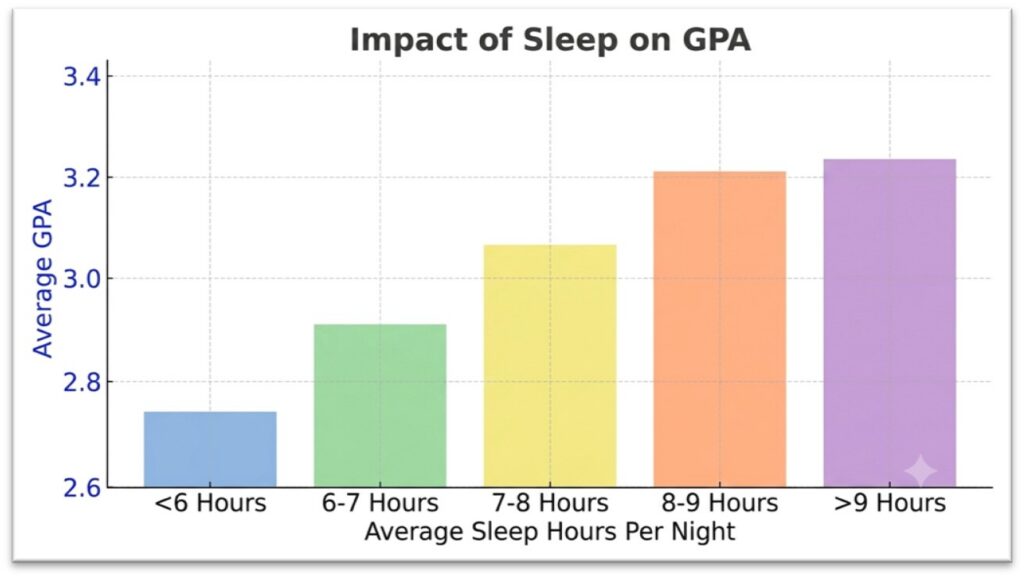
“It’s been measured,” Professor Bear says. “Researchers followed more than 600 first-year students across three universities with sleep trackers. Every extra hour of average nightly sleep early in the term predicted a 0.07 higher end-of-term GPA – and those students averaged just six and a half hours a night (Creswell et al., 2023). The short sleepers didn’t feel themselves falling behind. The grades simply came in lower.”
The gap between what you need and what you get
“Here is the collision,” Professor Bear says. “Young adults your age need 7 to 9 hours of sleep a night (Hirshkowitz et al., 2015), and the major sleep-medicine societies put the floor at 7 or more hours for any adult (Watson et al., 2015). Most college students don’t come close. About half report daytime sleepiness, and roughly 70% get insufficient sleep (Hershner & Chervin, 2014). You are running your fastest hardware on a chronic maintenance deficit.”
Maria is quiet for a second. “So, the all-nighter isn’t grit. It’s sabotage.”
“It’s a bad trade,” Professor Bear says. “You spend tomorrow’s faster brain and tonight’s cleanup to buy a few foggy hours. Here’s what I’d do instead.”
🐾 Your Next Move
Four moves. Start tonight.
- Treat sleep as a study tool, not a reward you earn after studying. Aim for 7 to 9 hours. It’s doing the filing and the cleanup your grades depend on. If you’re yawning before 5 p.m. – even after a heavy lunch – that’s a sign you’re not getting enough.
- Protect consistency. Same bedtime, same wake time – yes, including weekends. Consistency, not just total hours, tracked with better grades (Okano et al., 2019).
- Spread the work across the week instead of stacking it into one desperate night. Consolidation needs repeated nights of sleep, not one heroic one (Crowley et al., 2024).
- When the 1 a.m. voice starts negotiating, answer it honestly: that extra hour awake costs you tomorrow’s faster brain and tonight’s cleanup. Go to bed.
Isara closes her binder. She’s the one who said it first, and now she has the research behind her. “Sleep isn’t time away from the work,” she says.
Professor Bear smiles. “It’s the part of the work your brain does for you while you rest. You’re at the sharpest your raw processing will ever be. Don’t spend that edge running on empty.”
References
Creswell, J. D., Tumminia, M., Price, S., Sefidgar, Y. S., Cohen, S., Ren, Y., Brown, J., Dey, A. K., Dutcher, J. M., Villalba, D. K., Mankoff, J., Xu, X., Creswell, K. G., Doryab, A., Mattingly, S. M., Striegel, A., Hachen, D., Martínez, G. J., & Lovett, M. C. (2023). Nightly sleep duration predicts grade point average in the first year of college. Proceedings of the National Academy of Sciences, 120(8), Article e2209123120. https://doi.org/10.1073/pnas.2209123120
Crowley, R., Alderman, E., Javadi, A.-H., & Tamminen, J. (2024). A systematic and meta-analytic review of the impact of sleep restriction on memory formation. Neuroscience & Biobehavioral Reviews, 167, Article 105929. https://doi.org/10.1016/j.neubiorev.2024.105929
Eide, P. K., Vinje, V., Pripp, A. H., Mardal, K.-A., & Ringstad, G. (2021). Sleep deprivation impairs molecular clearance from the human brain. Brain, 144(3), 863–874. https://doi.org/10.1093/brain/awaa443
Hartshorne, J. K., & Germine, L. T. (2015). When does cognitive functioning peak? The asynchronous rise and fall of different cognitive abilities across the life span. Psychological Science, 26(4), 433–443. https://doi.org/10.1177/0956797614567339
Hershner, S. D., & Chervin, R. D. (2014). Causes and consequences of sleepiness among college students. Nature and Science of Sleep, 6, 73–84. https://doi.org/10.2147/NSS.S62907
Hirshkowitz, M., Whiton, K., Albert, S. M., Alessi, C., Bruni, O., DonCarlos, L., Hazen, N., Herman, J., Katz, E. S., Kheirandish-Gozal, L., Neubauer, D. N., O’Donnell, A. E., Ohayon, M., Peever, J., Rawding, R., Sachdeva, R. C., Setters, B., Vitiello, M. V., Ware, J. C., & Adams Hillard, P. J. (2015). National Sleep Foundation’s sleep time duration recommendations: Methodology and results summary. Sleep Health, 1(1), 40–43. https://doi.org/10.1016/j.sleh.2014.12.010
Miao, A., Luo, T., Hsieh, B., Edge, C. J., Gridley, M., Wong, R. T. C., Constandinou, T. G., Wisden, W., & Franks, N. P. (2024). Brain clearance is reduced during sleep and anesthesia. Nature Neuroscience, 27(6), 1046–1050. https://doi.org/10.1038/s41593-024-01638-y
Okano, K., Kaczmarzyk, J. R., Dave, N., Gabrieli, J. D. E., & Grossman, J. C. (2019). Sleep quality, duration, and consistency are associated with better academic performance in college students. npj Science of Learning, 4, Article 16. https://doi.org/10.1038/s41539-019-0055-z
Raichle, M. E., & Gusnard, D. A. (2002). Appraising the brain’s energy budget. Proceedings of the National Academy of Sciences, 99(16), 10237–10239. https://doi.org/10.1073/pnas.172399499
von Krause, M., Radev, S. T., & Voss, A. (2022). Mental speed is high until age 60 as revealed by analysis of over a million participants. Nature Human Behaviour, 6(5), 700–708. https://doi.org/10.1038/s41562-021-01282-7
Watson, N. F., Badr, M. S., Belenky, G., Bliwise, D. L., Buxton, O. M., Buysse, D., Dinges, D. F., Gangwisch, J., Grandner, M. A., Kushida, C., Malhotra, R. K., Martin, J. L., Patel, S. R., Quan, S. F., & Tasali, E. (2015). Recommended amount of sleep for a healthy adult: A joint consensus statement of the American Academy of Sleep Medicine and Sleep Research Society. Journal of Clinical Sleep Medicine, 11(6), 591–592. https://doi.org/10.5664/jcsm.4758
Wiehler, A., Branzoli, F., Adanyeguh, I., Mochel, F., & Pessiglione, M. (2022). A neuro-metabolic account of why daylong cognitive work alters the control of economic decisions. Current Biology, 32(16), 3564–3575.e5. https://doi.org/10.1016/j.cub.2022.07.010 Xie, L., Kang, H., Xu, Q., Chen, M. J., Liao, Y., Thiyagarajan, M., O’Donnell, J., Christensen, D. J., Nicholson, C., Iliff, J. J., Takano, T., Deane, R., & Nedergaard, M. (2013). Sleep drives metabolite clearance from the adult brain. Science, 342(6156), 373–377. https://doi.org/10.1126/science.1241224
[1]This early-twenties peak comes from standard processing-speed tests (Hartshorne & Germine, 2015), and it is debated. A re-analysis of more than 1.2 million people argued that raw mental speed holds roughly steady until about age 60, with earlier slowing reflecting a shift toward caution and accuracy rather than slower processing itself (von Krause et al., 2022). Either way, the practical point holds: a rested brain outperforms a sleep-deprived one.
[2] Whether sleep speeds the brain’s waste removal is an influential idea but not a settled one. The original mouse findings (Xie et al., 2013) and a human tracer study (Eide et al., 2021) support it, but a 2024 mouse study reported the opposite – that clearance of a fluorescent dye was markedly reduced, not increased, during sleep and anesthesia (Miao et al., 2024). The mechanism is still being worked out. Sleep’s role in memory consolidation and learning, however, is well established.