
The Hidden History of Financial Literacy
by Tiffany Isselhardt
In a perfectly set dining room, Nancy Abbey stood at the head of the table, stopwatch in hand. She watched her students race to plate a warm dinner before their imaginary husbands walked through the door – bringing bosses and their wives at the last minute. Nancy would check each dinner thoroughly. Was the silverware in the proper place? The gravy at the right temperature? The girls’ outfits clean despite having just rushed to turn a family meal into something to impress the boss and his wife, in hopes of a future promotion?
Nancy Abbey was a stereotyped character in Mona Lisa Smile – opposite Katherine Watson, a “progressive” art historian who challenged the female collegiates of Wellesley to further their education rather than choose marriage. Audiences are meant to smile, maybe wince, at how small Nancy’s world seems next to the existentialist debates elsewhere on campus. But strip away the film’s framing for a moment and look again at what’s actually happening in that room.
Nancy isn’t a punchline. She’s a college-educated woman running a rigorous, skills-based course grounded in a discipline that, by the 1950s, had its own university departments, research journals, and scientific underpinnings in chemistry, nutrition, and economics. What the movie renders as domestic theater was, in the real history of home economics, a hard-won field built largely by women who fought for recognition in institutions that didn’t want them studying science at all.
The Pathway
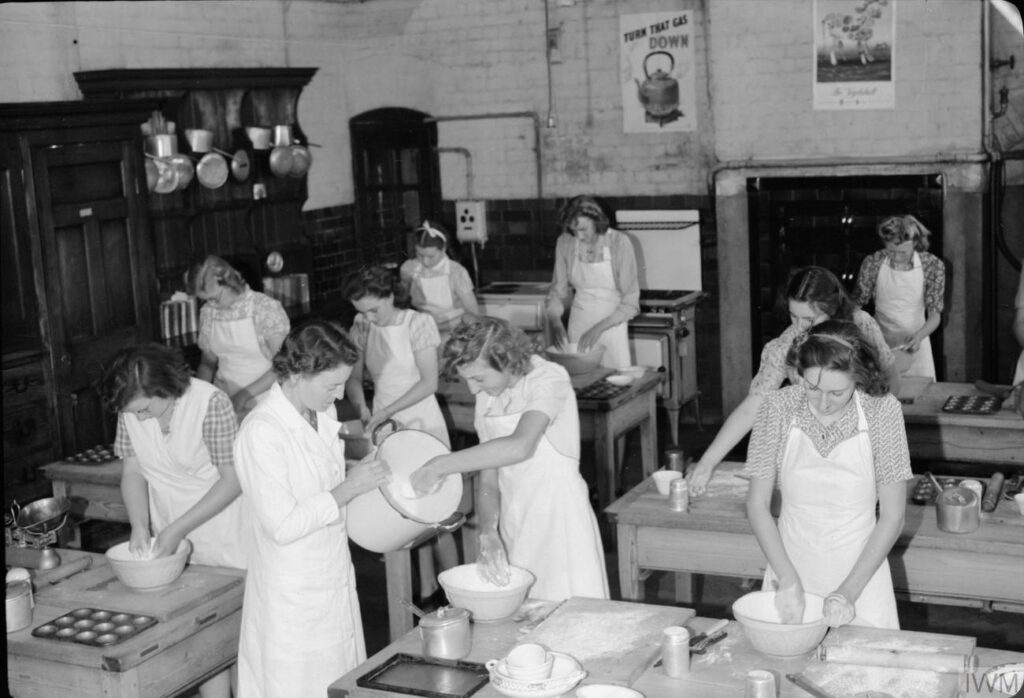
Home Economics arose from the convergence of three movements: 19th-century domesticity, which was increasingly standardized and marketed through magazines and advertisements; the Morrill Act of 1862, which established land-grant universities in every state that were open to women; and scientific innovations in domestic life that transformed the kitchen, laundry, sanitation, and medical care of the home – yet often required actual training for women to use. By 1899, the field of “home economics” had an official name – and in 1917, the Smith-Hughes Act mandated and provided federal funding for home economics classes, aiming to – as one historian summarized – “prepare student[s] for effective discharge of duties within the home and give scientific preparation for efficient administration of household affairs.”
Over the next few decades, women not only became managers of a scientific home – they became experts in it, earning doctoral degrees that led to advancements across a host of disciplines and transformed American society. But at their heart, home economists would impact women the most – providing them with practical skills that empowered them and their families.
May Cowles and the Advent of "Family Economics"
One of these educators was Dr. May Louise Cowles (1892-1978). Like the fictional Nancy Abbey, Dr. Cowles had a doctorate – in economics, from the University of Chicago (1929) – and was a faculty member (at UW-Madison). Though her major focus was clothing consumption, she taught the first Family Economics course at the University of Wisconsin – and would later advocate for the addition of economics to the curriculum.
Dr. Cowles focused Family Economics on topics we know – and focus on – today: the nature of family income, problems with income sources and distribution, the family budget, standards of living, and how expenditures change under different conditions. Her classes focused on real-world scenarios, asking students to produce realistic budgets that changed with proposed scenarios. She even had courses where students spent two weeks in a “practice home cottage” in order to solve real-world problems.
Specifically, Cowles built Family Economics on several topics she was already teaching:
-
-
- Household administration, which covered the economic functions of the home – history to the present time – and topics like standards of living, management of family incomes, household organization, and changes in economic markets (especially how this effects things like the price of goods and services). Students also completed a 1-2 week lab portion, where they lived full-time in a “practice cottage” to enact real-world scenarios.
- Problems of Consumption examined the household as a consumer – looking at how the family spends its income, scientific studies of expenditure patterns to understand trends, and examining standards of choice and how the character of goods shapes a family’s decisions. This is where Dr. Cowles addressed how to become a responsible consumer – considering factors like quality, cost, durability, safety, and ease of use in purchasing decisions, and how these factors are actually determined and reported to the public.
- Seminar in Housing Problems, which surveyed the origins of housing in the U.S. and its relationship to wealth distribution, land use, and transportation. Students also examined proposed solutions.
-
For Dr. Cowles and others, Family Economics was financial literacy – a crucial skill for any individual. By the postwar era, it became a standard part of the curriculum nationwide. Colleges even debated whether the courses should be taught to men (eventually, it was).
Navigating Uncertainty: Financial Literacy in the 20th Century
The impact of home and family economics courses – especially their financial literacy components – cannot be overstated. The generations of the 1900s to 1920s became prepared for the challenges of wartime shortages and the Great Depression – they knew how to manage limited incomes by tracking and examining patterns of spending. They also knew how to evaluate the character of goods in order to navigate the marketplace and purchase responsibly.
More importantly, home economics laid the foundation for women’s organizational capacity to collectively act on economics problems. They had networks from college and within their communities in order to create relief initiatives. They had financial skills that knew how to stretch a dollar – to get the most value, to make it cover needs rather than wants. And they knew how to economize. Depression-era skills weren’t just something they learned when faced with an economic downturn – it was something they had prepared for in the classroom – and were now ready to lead.
For most women, the lessons of Family Economics helped them face the rapid pace of the 20th century. After the Great Depression, women faced the turbulence of another world war: stretching dollars, prioritizing needs. They then faced a workforce that turned upside down, and societal standards that became more lenient on divorce – yet did not yet give women the ability to manage their own money independent of male supervision.
The End of an Era
In 1963, the Vocational Education Act diminished home economics education – restricting it only to education that would lead to gainful employment. As a largely women’s field, and one which was under fire during Second Wave Feminism, many schools decided to drop the programs entirely by the early 1970s. Others installed male heads, renamed the departments, and began campaigns of pushing female faculty out – favoring a focus on human development, nutrition, or other selections of the curriculum rather than the whole picture.
The results were rather disastrous – and you can see it today. Influencers sway us into the “next big thing” – a product that promises a cure. Misinformation that can lead to a bad investment. Uneasiness in the kitchen unless the meal comes from a delivery service, a box, or an app. Guesswork on which bill to pay and when. Unease as to whether medical bills will affect a credit score. Confusion on nutrition, exercise, selecting the next blender or clothing brand…
It doesn’t sound terrible as a single sentence, but when combined… how do these decisions effect a family?
Financial literacy – family economics – is a foundation on which a secure life is built. Though it survives now in Business or Family and Consumer Sciences departments, it is only recently that financial literacy has regained traction as a crucial educational touchpoint. As of July 2026, thirty-nine states require a standalone or embedded personal finance course for high school graduation – and the number continues to climb.
These courses still utilize the same topics that Cowles proposed nearly 90 years ago, adapted for the modern age. Budgeting is the anchor – how to manage the family’s income, standard of living, and organize the household, using the same types of tracking (now digital) that Dr. Cowles’s students utilized. They also explore the standards for choice – principles on how to be a “wise consumer” – and student price fluctuations, economic conditions, and theories. But today, our education goes beyond managing what you have andinto topics that were not as common, such as building wealth – through the stock market, something that most households did not engage in then due to pensions.
How to Learn Financial Literacy
The problem is that financial literacy skipped a few generations. From the late 1960s to the early/mid-2000s, family economics was not required in schools. It was learned only if parents or guardians taught it – and even then, the education could be limited. It was learned as-you-go, sometimes with dedicated vehicles like a piggy bank, a first debit card, or a first job.
But what if you didn’t have these opportunities – or aren’t sure about if you know enough?
Beyond the Bear Necessities is our forthcoming book on these topics – an introduction to personal finance in real-world terms. You’ll encounter financial topics in ways that are relevant to the issues you face today – and in the future. Every sentence was written with one thought in mind: What are the real-world questions that keep you up at night – and what evidence-backed strategies exist to help you navigate them?
Sign up for pre-orders and sneak peeks here.
There are other resources as well:
- Your local Cooperative Extension office may run free or low-cost classes on household management – a direct descendant of family economics.
- The National Endowment for Financial Education (NEFE) has published two handy guides: 40 Money Management Tips and Your Spending, Your Savings, Your Future: A Beginning’s Guide to Financial Readiness
- You can also check out Scholar Financial’s downloadable guides, including:
P.S. Want to learn more about the history of home economics? We recommend The Secret History of Home Economics: How Trailblazing Women Harnessed the Power of Home and Changed the Way We Live by Danielle Dreilinger.
Sources
- Equal Credit Opportunity Act, Pub. L. No. 93-495, 88 Stat. 1521 (1974) (codified at 15 U.S.C. § 1691 et seq.).
- Smith-Hughes National Vocational Education Act, Pub. L. No. 64-347, 39 Stat. 929 (1917).
- Apple, Rima D. The Challenge of Constantly Changing Times: From Home Economics to Human Ecology at the University of Wisconsin–Madison, 1903–2003. Madison: Parallel Press, University of Wisconsin–Madison Libraries, 2003. Accessed via UW-Madison Digital Collections: https://search.library.wisc.edu/digital/AHFCDPCK4BBAEN8X
- Cornell University Library. “From Domesticity to Modernity: What Was Home Economics?” Online exhibition, 2001 (archived version updated 2024). https://exhibits.library.cornell.edu/homeEc
- “The Fall of Home Economics.” Feminist Science (Substack), January 15, 2026. https://feministscientist.substack.com/p/the-fall-of-home-economics
- “The Great Depression.” Extension and the Fruits of Their Labor (online exhibit), North Carolina State University. https://soh.omeka.chass.ncsu.edu/exhibits/show/extension-family/extension-fruitsoflabor/extension-depression
- “History of Home Economics.” Home Economics and Household Management (course site), Middlebury College. https://sites.middlebury.edu/homeec/history-of-home-economics/
- National Endowment for Financial Education. “40 Money Management Tips Every College Student Should Know.” 2015 (originally 2011). https://www.nefe.org/initiatives/40-Money-Management-Tips.pdf
- National Endowment for Financial Education. “Your Spending, Your Savings, Your Future: A Beginner’s Guide to Financial Readiness.” 2017 (originally 2010). https://www.nefe.org/initiatives/Your-Spending-Your-Savings-Your-Future.pdf
- “Personal Finance Classes Are Now Mandatory In 28 States.” The College Investor, June 18, 2025. https://thecollegeinvestor.com/59265/personal-finance-classes-are-now-mandatory-in-28-states/
- Rossiter, Margaret. “The Men Move In: Home Economics in Higher Education, 1950–1970,” in Rethinking Home Economics: Women and the History of a Profession, ed. Sarah Stage and Virginia B. Vincenti (Ithaca: Cornell University Press, 1997), 96–117.
- School of Human Ecology, UW–Madison. “Timeline: 1930–1939.” https://humanecology.wisc.edu/timeline/1930-1939/
- University of Wisconsin Catalog, 1935–36. University of Wisconsin–Madison Digital Collections. https://search.library.wisc.edu/digital/ABHENFRWNLPB5O9B/text/A3OCVDKO6TCMGO8Z