
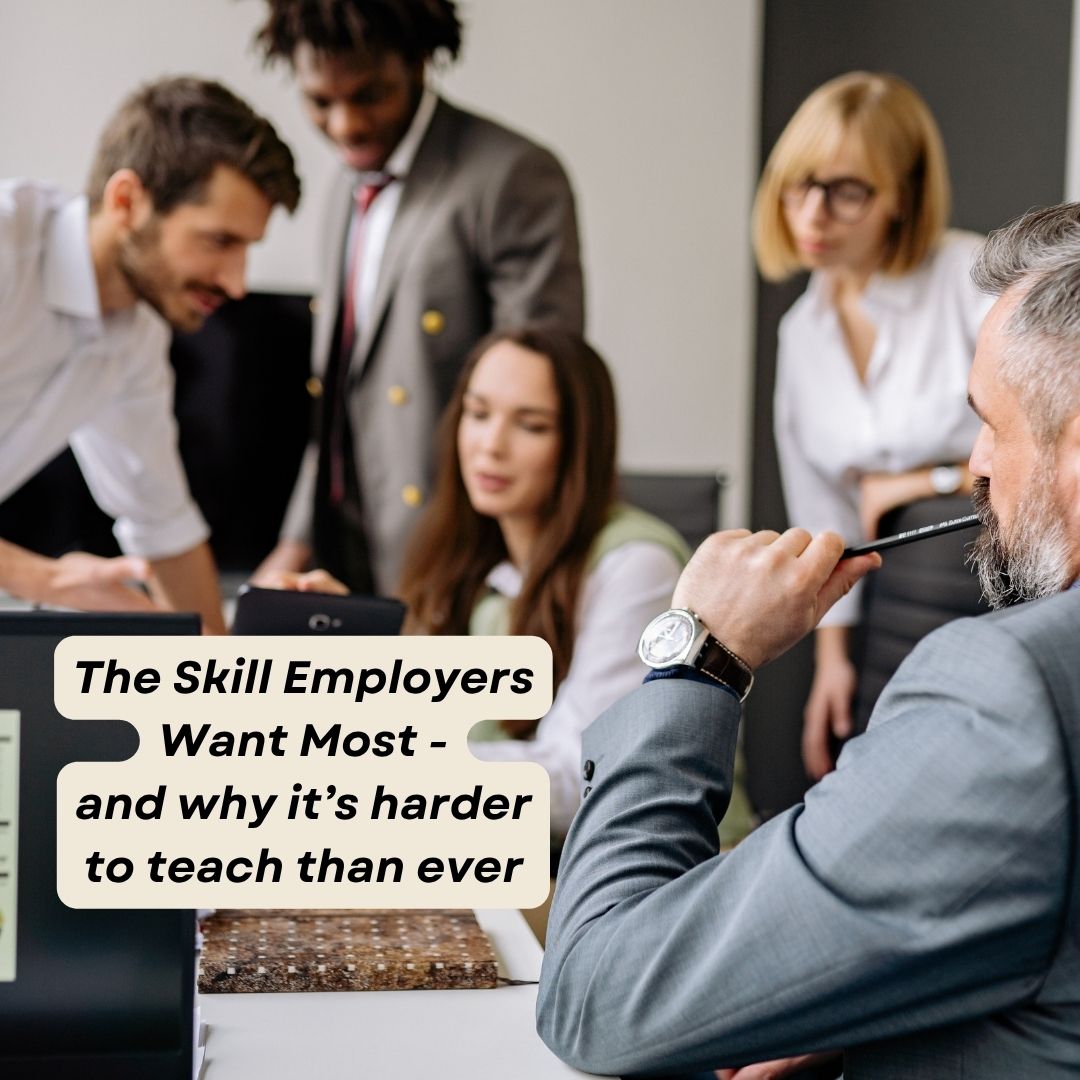
Why Critical Thinking is Harder to Teach than Ever – and Why That Should Worry Anyone Who Cares about the Next Generation
Ask employers what they want most from college graduates and the answer has been remarkably consistent for more than a decade. The American Association of Colleges and Universities, the National Association of Colleges and Employers, the World Economic Forum, the major consulting firms, and survey after survey of hiring managers all return the same finding.
The skill at the top of the list is not coding. It is not data analysis. It is not communication, though that ranks high. It is critical thinking – the capacity to take in information, evaluate it, identify its weaknesses, distinguish strong evidence from weak, and reach a defensible judgment under uncertainty.
Employers want this skill so consistently because the jobs college graduates are walking into demand it. The graduate who joins a financial planning firm, hospital administration office, marketing team, government agency, or software company will be expected – often within weeks – to evaluate proposals, assess risks, weigh competing recommendations, and reach conclusions whose consequences other people will live with. The capacity to do this well is what the diploma is supposed to certify. It is increasingly what the diploma fails to certify.
Hiring managers consistently rate recent graduates as deficient in precisely the analytical and evaluative skills the same managers rate as most important – a 2018 study reported that the largest gaps were critical thinking, problem-solving, and the ability to apply knowledge to real-world settings.[1] The graduates themselves often report feeling unprepared. In a 2025 survey of 971 recent graduates by Cengage Group, nearly half reported feeling unprepared for the job market.[2] Remarkably, the gap is striking when comparisons are done between employers and their recently grad employees: the NACE Job Outlook for 2022 reported that nearly 79.8% of students rated themselves as very or extremely proficient in critical thinking, while just 55.8% of their employers agreed with that assessment – a difference of 24%.[3]
The complaint is not that students lack content knowledge (they often have plenty) but that they cannot do much with it. They struggle to distinguish a sound argument from a fluent one, to identify the unstated premise in a recommendation, to notice when a chart is making a claim its data does not support, or to revise a position when better evidence arrives. These are not exotic capacities. They are the cognitive minimum for adult professional life, and the gap between expectation and delivery has become a national workforce problem that no amount of sector-specific training can paper over.
What Critical Thinking Actually Is
Part of the difficulty in addressing the deficit is that the phrase “critical thinking” has been so widely used that it has nearly lost its meaning. It is worth restoring some precision. Critical thinking is not skepticism, though it includes skepticism. It is not contrarianism. It is not the reflex of doubting whatever an authority happens to say. It is a disciplined cognitive practice with identifiable components, and those components have been mapped in considerable detail by researchers in cognitive psychology and educational philosophy over the past forty years.
At its core, critical thinking is the practice of holding a claim – one’s own or someone else’s – at arm’s length long enough to ask a series of structured questions about it. What exactly is being asserted? What evidence supports the assertion, and how strong is that evidence? What alternative explanations are consistent with the same evidence? What unstated assumptions does the argument depend on, and are those assumptions defensible? What would change my mind? Is my own initial reaction to this claim a reliable guide, or is it a product of motivated reasoning, tribal loyalty, or something I would rather not examine?
The trained critical thinker performs this sequence rapidly and almost unconsciously, the way a trained musician performs scales. The untrained mind does not perform it at all, and substitutes for it the much faster reflexes of recognition, familiarity, and emotional resonance – the same reflexes that make social media feeds so addictive and so corrosive.
The capacity is built, not given. Like any cognitive skill that runs against the grain of the brain’s natural shortcuts, it must be developed through repeated, effortful practice over years. A student who has done the work emerges with something close to a habit of mind: a disposition to ask the structured questions automatically, even about claims the student would prefer to accept. A student who has not done the work emerges with the verbal forms of critical thinking – the vocabulary, the appearance of analysis – without the underlying cognitive habit. The difference becomes visible the first time the student encounters a fluent, confident, well-marketed claim that happens to be wrong.
How College is Supposed to Build It
The pedagogy that builds genuine critical thinking is not mysterious, and it has been refined over centuries. It involves the assignment of difficult primary readings the student initially resists or misunderstands. It involves seminar discussion in which positions are stated, defended, and revised under questioning from peers and instructor. It involves writing – substantial, original writing, marked up in detail by a faculty member who pushes back, demands evidence, identifies weak reasoning, and requires revision. It involves examinations that ask the student to apply principles to unfamiliar cases rather than recite memorized material. It involves, crucially, sustained exposure to the strongest versions of arguments the student finds uncomfortable, presented by people who genuinely hold those arguments and can defend them well. The student who has spent four years in this kind of environment has, almost as a byproduct, built the cognitive machinery employers say they want.
Each element of this pedagogy serves a specific function:
- The difficult reading forces the student to slow down and grapple with thinking that does not match the student’s prior categories.
- The discussion forces the student to articulate a position out loud and then defend it against objections, which is how the student discovers that the position has weaknesses the student did not see in private.
- The graded essay, returned with substantive comments and a requirement to revise, forces the student to confront the gap between what the student meant to argue and what the writing actually demonstrated.
- Sustained exposure to strong opposing views builds the habit of taking those views seriously rather than dismissing them, which is the only way the student ever learns to evaluate their own views – and those of others – and to respect informed opinions when encountered and deliberated.
None of these practices are decorative. Each is doing identifiable cognitive work, and removing any of them removes a piece of the machinery the rest is supposed to produce.
The Pressures That Make This Harder
This pedagogy has always been demanding. It is now operating under conditions that have made it considerably harder, and some of those conditions arise from ideological pressures on the institutions where the pedagogy takes place. The pressures come from both directions, they vary substantially across institutions, and the responses by faculty and administrators vary as well. It is important to be precise about all three points.
From what is loosely called “the right,” the pressures are increasingly external and legislative. Florida’s reforms under recent administrations, Texas Senate Bill 17, and similar interventions in roughly two dozen states have used state authority to restrict what may be taught, which programs may be funded, which faculty may be hired, and which concepts may appear in curricula.[4] Some of these interventions began as responses to genuine excesses in the academy, but the chosen instrument – political control of curriculum and personnel – does not produce more rigorous thinking. It produces safer thinking, defined as thinking that does not embarrass the political authority doing the controlling.
From what is loosely called “the left,” the pressures tend to be internal and cultural. Some surveys document campus environments in which significant fractions of students and faculty self-censor on politically sensitive topics for fear of social, professional, or formal consequence.[5] The mechanisms include hiring norms, disciplinary fashion, social media reputational risk, and the slow accretion of which views are sayable in a faculty meeting without cost.
Both sets of pressures attack the same conditions critical thinking pedagogy depends on – and the results are that a startling 42% of faculty report being likely to self-censor in classroom discussion or lectures while up to half of all faculty say they have difficulty talking about racial inequality, transgender rights, affirmative action, and the presidential election – all topics that require critical thinking and will face recent graduates in a variety of workplace contexts.[6]
Tenure exists to protect the faculty member who reaches an unpopular conclusion; both political interference and informal professional sanction erode that protection. Curricula need to include the strongest versions of uncomfortable arguments, regardless of which direction the discomfort runs; both state-imposed restrictions and informal pressure on syllabi narrow what curricula can contain. Classrooms need to be places where positions can be stated and tested without tribal cost; both forms of pressure raise that cost. This matters for the skills gap described above: critical thinking and analytical reasoning are not acquired by absorbing settled conclusions but by practicing the act of examining a claim, weighing evidence against it, and defending or revising a position under challenge. A classroom that quietly narrows which claims are available for that kind of scrutiny is, to that extent, a classroom that offers less practice in the skill employers say graduates lack.[7]
These two sets of pressures vary enormously by institution, by state, by department, and by individual instructor, and many faculty members resist them with real courage. That variation matters: few campuses resemble the caricatures drawn by their critics, and what any particular classroom feels like depends less on broad trends than on the specific person standing at the front of it.
It is worth being honest about a smaller but consequential subset of voices on both far ends: some on the far left and some on the far right do not actually want students exposed to opposing views at all. They do not want the case for free-market economics genuinely presented alongside the case for stronger consumer protection regulation. They do not want religious traditions presented alongside secular and pluralist alternatives. They do not want students to encounter, in any sustained way, the evidence that some groups in American society face structural challenges others do not — or, on the other side, the evidence and arguments that complicate or contest particular framings of those challenges. The shared conviction underneath these otherwise opposite positions is that students cannot be trusted to evaluate competing views and reach their own conclusions and must therefore be insulated from the views the gatekeeper has prejudged as wrong. This is the opposite of a critical-thinking education. It is indoctrination, and it produces graduates who have been told what to think rather than taught how. The motivation – whether the gatekeeper is a politician, a parent, a donor, or a campus activist – is often the same and rarely stated aloud: an unwillingness to risk that the views and principles the gatekeeper holds dear might not survive serious scrutiny, and a fear that the young minds they have shaped — through upbringing, community, or ideology — might, on encountering opposing ideas presented honestly, begin to question, revise, or even reject the doctrine they were given. The fear is not unreasonable. That is precisely what a real education sometimes does. It is also, for the student, precisely the point.
What This Looks Like in an Actual Classroom
The abstract description of these pressures becomes concrete the moment one stands in front of a roomful of students and tries to do the work. Consider some of the topics a serious instructor in a personal finance degree program or in a personal-development course needs to address with current undergraduates:
- How to learn effectively – which requires confronting the documented harms of multitasking, the cognitive cost of constant phone checking, and the way social media platforms have been engineered to exploit attentional vulnerabilities. The data on these harms differs by gender in ways that matter pedagogically: young women and young men are not affected identically by the same platforms – they often suffer from different psychological harms, and pretending otherwise is bad teaching.
- The rapid rise of sports gambling on college campuses, particularly among young men, with documented financial and mental health consequences that an instructor has a duty to discuss honestly.
- The economic implications of declining birthrates in developed countries, the multiple causes contributing to that decline, and the long-term workforce and public-finance consequences students will inherit.
- The financial planning needs of same-sex couples, which differ in concrete and important ways from those of opposite-sex couples and which a student in a personal finance curriculum is professionally obligated to understand if the student plans to advise clients.
- The particular challenges first-generation college students face – financial, social, informational – that students from college-educated families do not, and the specific strategies that help close the gap.
Each of these topics matters for the student’s actual life and career. Each of them, in the current environment, is a topic some students have been told should not be discussed in college classrooms – by parents, by community leaders, by political figures, or by peers enforcing campus orthodoxies of one kind or another. The instructor who raises these topics honestly is going to make some students uncomfortable. The discomfort is not a bug. It is part of how critical thinking gets built. The seminar in which a student is asked to consider whether the gambling app the student uses every Sunday is engineered to extract money from users like the student, and to evaluate the evidence on either side, is doing exactly the cognitive work the student needs. The discussion in which the financial planning needs of same-sex couples are presented as a matter of professional competence rather than political position is teaching the student that careful analysis can and should be applied to topics the student’s communities may have flagged as off-limits.
But the instructor who raises these topics now does so under conditions that did not exist a generation ago. Student complaints can be filed and amplified rapidly. Recordings of class sessions can be posted out of context. Political pressure from outside the institution can land on a single faculty member through channels that did not previously exist. Internal campus politics can punish a faculty member from a different direction for the same lecture. The instructor faces a calculation the older generation of professors largely did not face: which examples are worth the risk, which honest observations are worth the email storm, which difficult but accurate readings are worth the meeting with the dean. Many faculty members make these calculations courageously and continue to teach demanding material. Others, entirely understandably, begin to soften. They drop the difficult reading. They avoid the gendered-data example. They use the safer case study. They confine themselves to the technical material and skip the application that would have required taking up a contested topic.
The cost of this softening is not borne by the faculty member. It is borne by the student, who graduates without having had the harder conversation, without having been pushed to defend a position under questioning, without having seen a faculty member model the practice of taking up an uncomfortable subject and reasoning about it carefully in real time. The student has been protected from a few uncomfortable hours and has paid for the protection with a portion of the cognitive equipment the next forty years were going to require. It is a bad trade, made for the student rather than by the student, by people whose own incentives have been distorted by pressures the student does not see.
The Habits the Brain Has to Build
Underneath all of this is a fact about how the brain learns that no amount of curricular adjustment can work around: Critical thinking is a habit, and habits are built by repeated, effortful practice in conditions that resemble the conditions in which the habit will eventually be used.
A student who never has to defend a position out loud in front of skeptical peers does not build the habit of defending positions out loud. A student who never has to revise a written argument in response to substantive criticism does not build the habit of revising arguments. A student who never encounters a strong version of a view the student finds repugnant does not build the habit of taking such views seriously, which means the student never builds the capacity to evaluate the student’s own views by contrast. The brain develops the capacities it is asked to develop and lets others atrophy, and the years spanning late adolescence and early adulthood — roughly the college years — appear to be among the last stages in which core capacities for reasoning, judgment, and self-regulation are still actively stabilizing into their adult form.[8]
This is why the current pressures are particularly costly. They are not merely making certain conversations harder. They serve to deny to some students, during the developmental window in which the relevant cognitive habits are most easily built, some portion of the multitude of experiences necessary to build such habits. A graduate who has been spared difficult conversations for four years has not been protected. The graduate has been disarmed.
The World Students Face Next
What our students have been disarmed against is not theoretical. The information environment the next generation will inhabit is one in which fluent, confident, plausible-sounding text can be generated in unlimited quantities by systems that have no understanding of truth and no stake in accuracy. The voter, the patient, the investor, the parent, the juror, the citizen will be making consequential decisions based on machine-generated material whose surface fluency outruns its underlying reliability. Employers know this is coming. It is part of why their demand for critical thinking has become so insistent. The hiring manager who used to be able to assume that a college graduate could distinguish a sound argument from a fluent one can no longer make that assumption, and the cost of misjudging in this new environment is much higher than it used to be.
A graduate equipped with genuine critical-thinking habits will navigate this world with the cognitive tools it requires. A graduate without them will be what the technology and the people deploying it would like the graduate to be – fluent in the right verbal forms, confident in the conclusions the surrounding information environment has supplied, and unable to tell when the confidence is warranted. The difference between these two graduates will determine, in aggregate across millions of cases, whether the next generation can govern itself, plan its economy, raise its children, and steward its institutions. The stakes do not get higher than this.
What They Deserve – and What We Can Give
The students did not create the pressures bearing down on the institutions they attend. They did not choose the historical moment into which they are graduating. They will inherit the consequences of both regardless. They deserve a higher education that takes seriously what employers, citizens, and the students themselves will eventually need – and that defends the conditions of genuine inquiry against pressure from whichever direction is closest to home, which is always the harder direction to see.
Critical thinking is built slowly, through years of structured practice, by faculty willing to take on difficult subjects in front of students who would sometimes prefer to be spared them. The faculty who continue to do this work, often at real personal cost, are doing more for their students than the students yet realize. The institutions that protect such faculty, and the cultures that encourage them, will produce the graduates the country needs. The institutions that do not will produce credentialed adults who never developed the cognitive habits their working lives, their civic lives, and their personal lives will require. The diploma will look the same. The education will not be.
[1] Hart Research Associates (2018), as cited in: Critical Thinking: Creating Job-Proof Skills for the Future of Work, PMC, https://pmc.ncbi.nlm.nih.gov/articles/PMC10607682/
[2] Cengage Group (2025), as reported in: Newsweek, “Most Recent Graduates Can’t Find a Full-Time Job From Their Degree,” Sept. 11, 2025. https://www.newsweek.com/most-recent-graduates-cant-find-full-time-job-their-degree-2128400
[3] Staffing Industry Analysts, “Recruiters’ and students’ perceptions of career readiness don’t align: NACE,” Sept. 5, 2023. https://www.staffingindustry.com/news/global-daily-news/recruiters-and-students-perceptions-career-readiness-dont-align-nace
[4] DESANTIS BANS STATE FUNDING FOR DIVERSITY, INCLUSION PROGRAMS AT FLORIDA PUBLIC UNIVERSITIES; Fox News, “Texas takes step to ban diversity offices at public universities,” 2023. https://foxnews.com/politics/texas-takes-step-ban-diversity-offices-public-universities-strongest-pushback-woke-policies.amp; Ogletree Deakins, “New Texas Law Prohibiting Institutions of Higher Education From Establishing or Maintaining DEI Offices Is Now Effective,” Jan. 6, 2024. https://ogletree.com/insights-resources/blog-posts/new-texas-law-prohibiting-institutions-of-higher-education-from-establishing-or-maintaining-dei-offices-is-now-effective/; MOST Policy Initiative, “DEI Restrictions,” citing The Chronicle of Higher Education (2025). Since 2023, 18 states (AL, AR, FL, ID, IN, IA, KS, KY, MS, NC, ND, OH, OK, TN, TX, UT, WV, WY) have passed legislation that restricts DEI initiatives in public higher education institutions.
https://mostpolicyinitiative.org/science-note/dei-restrictions/; The Chronicle of Higher Education, “New Anti-DEI Legislation Goes Into Effect in 4 States,” Jan. 13, 2026. Since the beginning of this year, state lawmakers have introduced at least 39 bills meant to eliminate or restrict higher education’s diversity, equity, and inclusion programs in 19 states.
https://www.chronicle.com/article/new-anti-dei-legislation-goes-into-effect-in-4-states
[5] Inside Higher Ed, “FIRE report: students are censoring their opinions,” Sept. 29, 2020. https://www.insidehighered.com/news/2020/09/29/fire-report-students-are-censoring-their-opinions; FIRE, “College faculty are more likely to self-censor now than at the height of McCarthyism,” Dec. 19, 2024. We found that self-censorship on US campuses is currently four times worse than it was at the height of the McCarthy era. Today, 35% of faculty say they have toned down their written work for fear of causing controversy.
https://www.fire.org/news/college-faculty-are-more-likely-self-censor-now-height-mccarthyism
[6] Honeycutt, N. (2024). Silence in the Classroom: The 2024 FIRE Faculty Survey Report. The Foundation for Individual Rights and Expression. https://www.thefire.org/research-learn/silence-classroom-2024-fire-faculty-survey-report
[7] “Argumentative Reasoning: Development, Training, and Relevance to Academic Outcomes,” PMC. https://pmc.ncbi.nlm.nih.gov/articles/PMC12729502/
[8] Tervo-Clemmens, B., Calabro, F. J., Parr, A. C., Fedor, J., Foran, W., & Luna, B. (2023). A canonical trajectory of executive function maturation from adolescence to adulthood. Nature Communications, 14, 6922. https://doi.org/10.1038/s41467-023-42540-8; Cleveland Clinic. “Prefrontal Cortex: What It Is, Function, Location & Damage.” https://my.clevelandclinic.org/health/body/prefrontal-cortex