
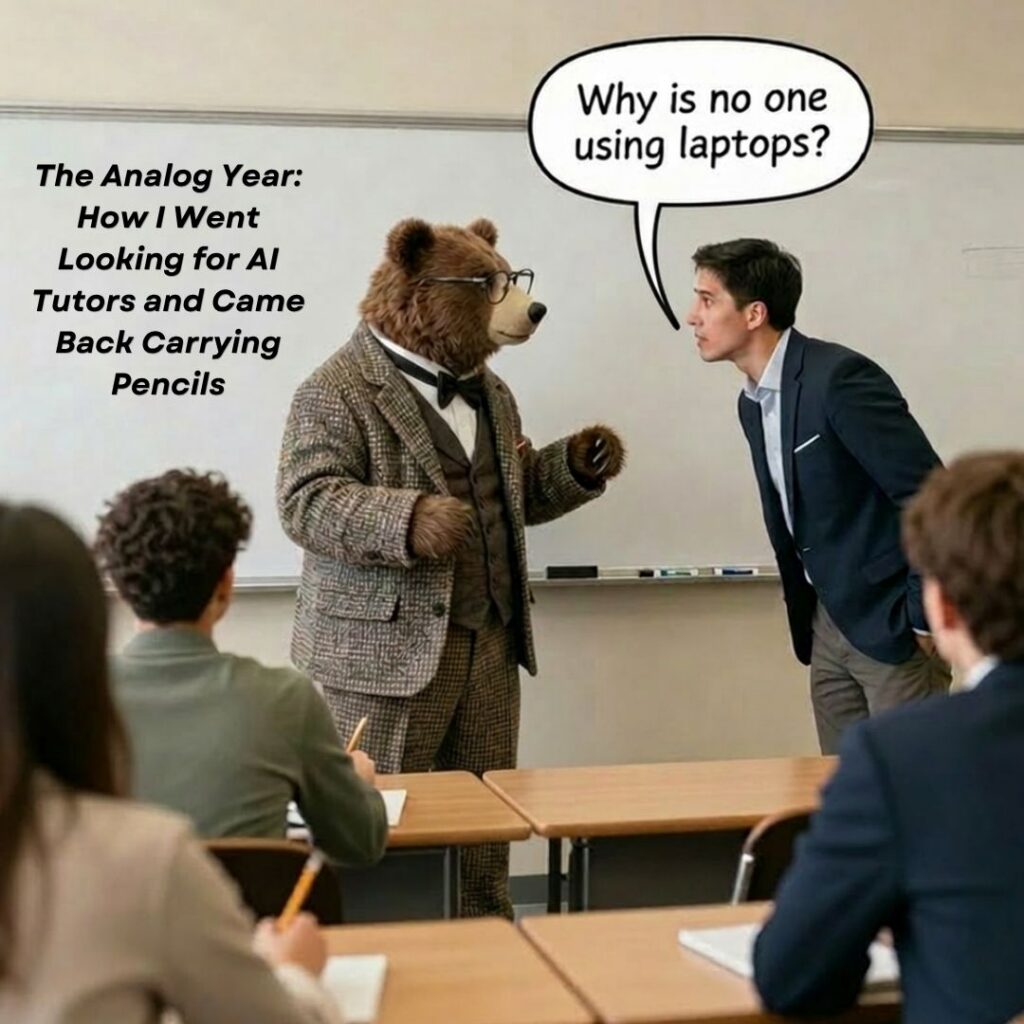
A guest speaker in my Applied Investments course paused mid-sentence, scanned the room full of business majors, and asked the question I’d been quietly asking myself for a year:
“Why is nobody on a laptop?”
A student answered before I could. She said she’d stopped taking notes on a laptop – in this class, and now in her others – because writing by hand was the only way the material actually stuck.
Eighteen months earlier, I would have been the professor handing out the laptops.
How a year chasing AI led me to paper
Over a year ago I became intrigued with the possibility that AI tutors could deliver Oxbridge tutorials at scale – and I went looking for AI tutors. The promise is real and, frankly, thrilling: a patient, one-to-one tutor for every student, available at midnight, scaled to a whole class. Benjamin Bloom named the prize back in 1984 – his “two-sigma problem,” the finding that one-to-one tutoring could move the average student far beyond the average lecture (although subsequent research revealed positive results, not quite at that scale) (Bloom, 1984). Forty years later, AI finally looks like it might deliver tutoring at scale.
But before I could evaluate any tool, I had to answer a more basic question: What actually works to produce learning?
Notice I said learning, not teaching. A long time ago, I stopped designing my courses around the instructor and started designing them around the learner. Any technology I adopted had to earn its place against that standard.
Long a student of pedagogical techniques, I went back to the science. And two bodies of evidence pulled in opposite directions.
The first was about technology in the classroom – and it was more sobering than I expected. Reading on screens produces measurably shallower comprehension than reading on paper, especially for dense informational text (Delgado et al., 2018). Laptops open in a lecture hall depress learning, and not just for the person typing, but also for the classmates in view of the screen (Sana et al., 2013). And in 2024, researchers using high-density EEG found that writing by hand generates far richer connectivity in the brain regions tied to memory and encoding than typing does (Van der Weel & Van der Meer, 2024). The pen really is doing something the keyboard isn’t.
The second body of evidence was about AI specifically – and it told a two-sided story. In a Wharton-led field experiment, students given an unrestricted GPT-4 tutor improved 48% while they had it – then scored 17% worse than their peers once it was taken away (Bastani et al., 2025). The crutch left them weaker. A separate study described what the authors called “cognitive debt”: when students offloaded the thinking to a language model, their own neural engagement dropped, and the understanding was never really theirs (Kosmyna et al., 2025). Meanwhile, a Harvard randomized trial showed the opposite is also possible – a carefully engineered AI tutor helped students learn more than twice as much as a strong active-learning class, in less time. The catch: that result came from three instructors spending six months building tutors for just two lessons. The gains came from the design, not the chatbot (Kestin et al., 2025).
That’s where I landed by the fall of 2025: AI tutors are genuinely promising but doing them well still demands enormous time to design, implement, and monitor. (That calculus is already shifting as better tutor-building platforms arrive – more on that below.)
What I saw my own students doing
While I was studying AI, my students were already using it – to do the very work that was supposed to make them think.
AI was generating their social-annotation comments on the readings. It was writing their in-class reflective statements submitted online to our LMS. Some were quietly recording class and feeding it to AI for a summary. Each of these activities involved the hard, valuable part of learning: applying a concept to a messy fact pattern, comparing and contrasting, making the idea personally yours. And AI made it frictionless to skip.
That’s the trap. The struggle isn’t a bug in learning – it is the learning. Remove it, and you remove the thing that builds the mind.
So I went (mostly) analog
I didn’t ban technology. I redesigned the friction back in.
I kept my weekly Class Preparation Assignments in Perusall, the social reading platform. It works: social annotation pushes the share of students who actually do the reading from the usual 20–30% up toward 90%, and mine were arriving each week having genuinely read. But I cut the annotations to one per reading – and required that the annotation (or a reply to a classmate) include something personal: their own example, their own doubt, their own connection.
Then I brought back the worksheet. Students handwrite them, scan them, and submit to the LMS. Some use Feynman boxes: explain this concept in plain language, as if teaching it, which ruthlessly exposes the gaps a highlighter hides. Others pose a hypothetical and make the student apply the concept to it.
During class sections, more worksheets: team problems, retrieval-practice rounds, exercises that force application instead of recognition. Every sheet leaves a space I’ve come to think of as the most important real estate on the page: What are you still uncertain about? I answer most of those questions individually in the LMS, then review them at the start of the next class.
The grading changed to match. Across the term there were 45 worksheets – 12 out of class, 33 in class – each worth 10 points (out of 1,000 total) and graded on effort, not perfection, plus 12 weekly readings. I cut the course down to just two exams. The result is dozens of low-stakes reps: retrieval practice, spacing, and application, built into the rhythm of the course instead of crammed the night before a high-stakes test. It also takes the fear out of the room.
None of this is folk wisdom. It’s retrieval practice, spaced and interleaved review, desirable difficulty, the testing effect, handwriting for encoding – the most durable findings in the science of learning. AI’s most seductive feature is that it erases exactly those difficulties. My job became protecting them.
Did it work?
Attendance went up. Participation went up. And the learning – by every measure I can see – improved.
I didn’t spring this on anyone. The semester opens with a short module on learning how to learn, and we revisit the reasons behind the analog worksheets several times. Students don’t resent friction they understand.
Their words, from anonymous end-of-term surveys, say it better than I can:
“Handwritten notes have helped so much – I don’t use my laptop for notes in my other classes now.”
“Yes, they helped, because I actually had to read and write my answers by hand.”
“Never had to study for the exams, because the work Dr. Bear gave us was making me apply it to the handwritten submissions.”
“Quite literally the greatest class I have ever taken.”
One comment stated: “The majority of professors tell students to study but don’t take the time to help us understand how to study effectively.”
That sentence is why I do the “learning how to learn” module.
I’ll be honest about the friction, too. A few students found one reading platform plus handwritten work redundant, and one wrote that he got so focused on filling in the sheet that he stopped listening. Fair. I’m still tuning the balance between capturing answers and thinking out loud. I don’t have this all figured out – since COVID I’ve revised my pedagogy several times, because the students (and the challenges they face) keep changing and so must I.
This is not a rejection of AI
Far from it. For several in-class exercises, I tell students to bring their laptops so we can practice AI prompting deliberately. In one course, we built an AI agent together. I teach students to use large language models for Socratic self-quizzing when they review. My major weaves still more AI instruction into other courses. The goal was never to keep AI out; it was to make sure students bring a mind to it.
And I remain an optimist about AI tutors. The Harvard result tells me the ceiling is real: well-designed AI tutoring can reach the gains Bloom dreamed about. The barrier has been the labor of building them well, and that barrier is falling fast as tutor-design platforms mature. The future I see isn’t analog versus AI. It’s this: we use AI to deliver practice, feedback, and personalization at a scale one professor never could, while we fiercely protect the cognitive work that actually grows a learner. Retrieval. Struggle. Explanation. Judgment. The pen, this past year, simply kept me honest about which was which.
We are not choosing between the keyboard and the pencil. We are learning, finally, when each one makes us think.
What’s the smartest “low-tech” move you’ve made in your own teaching this year – and what did your students say about it? Have you utilized AI tutors? I’d love to hear about your own innovations.
Sources
Bastani, H., Bastani, O., Sungu, A., Ge, H., Kabakcı, Ö., & Mariman, R. (2025). Generative AI without guardrails can harm learning: Evidence from high school mathematics. Proceedings of the National Academy of Sciences, 122(26), e2422633122. https://doi.org/10.1073/pnas.2422633122
Bloom, B. S. (1984). The 2 sigma problem: The search for methods of group instruction as effective as one-to-one tutoring. Educational Researcher, 13(6), 4–16. https://doi.org/10.3102/0013189X013006004
Delgado, P., Vargas, C., Ackerman, R., & Salmerón, L. (2018). Don’t throw away your printed books: A meta-analysis on the effects of reading media on reading comprehension. Educational Research Review, 25, 23–38. https://doi.org/10.1016/j.edurev.2018.09.003
Kestin, G., Miller, K., Klales, A., Milbourne, T., & Ponti, G. (2025). AI tutoring outperforms in-class active learning: An RCT introducing a novel research-based design in an authentic educational setting. Scientific Reports, 15, Article 17458. https://doi.org/10.1038/s41598-025-97652-6
Kosmyna, N., Hauptmann, E., Yuan, Y. T., Situ, J., Liao, X.-H., Beresnitzky, A. V., Braunstein, I., & Maes, P. (2025). Your brain on ChatGPT: Accumulation of cognitive debt when using an AI assistant for essay writing task [Preprint]. arXiv. https://arxiv.org/abs/2506.08872
Sana, F., Weston, T., & Cepeda, N. J. (2013). Laptop multitasking hinders classroom learning for both users and nearby peers. Computers & Education, 62, 24–31. https://doi.org/10.1016/j.compedu.2012.10.003
Van der Weel, F. R., & Van der Meer, A. L. H. (2024). Handwriting but not typewriting leads to widespread brain connectivity: A high-density EEG study with implications for the classroom. Frontiers in Psychology, 14, Article 1219945. https://doi.org/10.3389/fpsyg.2023.1219945
It’s quite shocking to realize the understanding that traditional ways of learning are substantial! These techniques that I have learned, have also helped me use AI better. If I really don’t understand something for the series 65, I always ask it to explain it like the explaining is being done to a 12-year-old. I also find it funny that you played a role in making the series 65 harder because I recognized all the techniques you mentioned in class inside the first chapter of the LEM!