
There is a moment I have witnessed hundreds of times across more than two decades of teaching, and it never loses its power. A student walks into my office defeated – by a grade, by a rejection, by the slow dawning realization that the world does not arrange itself neatly around the plans we make at eighteen. And somewhere in the course of our conversation, something shifts. Not because I offer a solution, but because the student begins, often for the first time, to see the difficulty not as evidence of their inadequacy but as the raw material of their growth.
That shift – quiet, internal, easily missed if you are not watching for it – is the most important thing that happens in a university. It is more important than any lecture I will ever give.
I have spent my various careers at the intersection of human development, learning science, and the sociology of work, studying how people move from potential to capability, from fragility to resilience, from self-doubt to self-possession. And I have arrived at a conviction that shapes everything I do: the most consequential outcomes of education have very little to do with content. Facts can fade. Formulas are often forgotten. Theories are revised and sometimes discarded. But certain qualities, once rooted in a person’s character, tend to govern everything that follows – how they think, how they relate to others, how they respond to setback and ambiguity, and how they ultimately contribute to the world beyond the university walls.
The research on human development bears this out with striking consistency. From Carol Dweck’s landmark work on implicit theories of intelligence to Angela Duckworth’s studies of passion and perseverance, from Lev Vygotsky’s foundational insights on social learning to the contemporary psychological research on self-regulation, metacognition, and emotional intelligence, the evidence converges on a single conclusion: the traits that predict long-term flourishing – in careers, in relationships, in the private interior of a well-lived life – are dispositional, not informational. They are habits of mind and character, cultivated over time through practice, through reflection, and through the kind of mentorship that asks more of a student than the student yet knows how to ask of themselves.
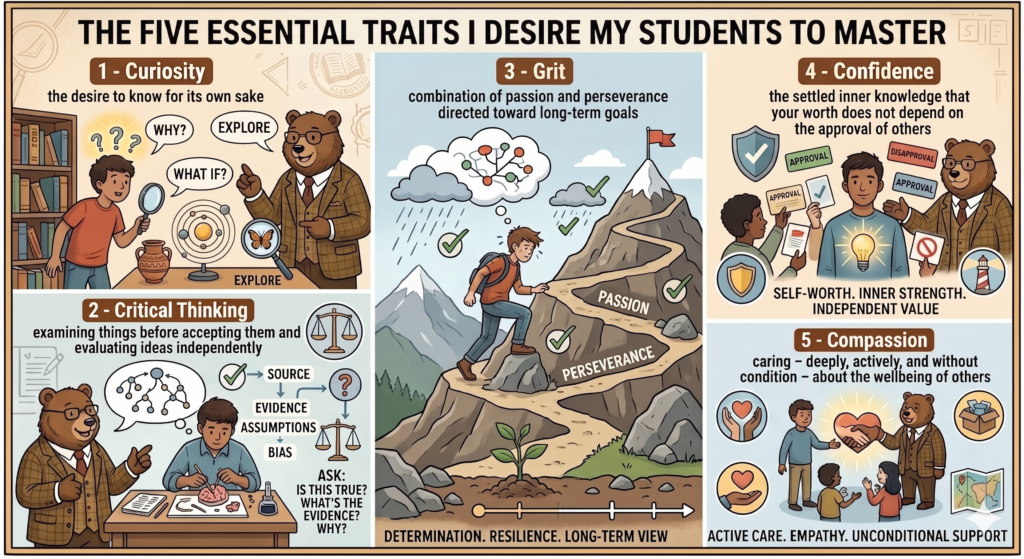
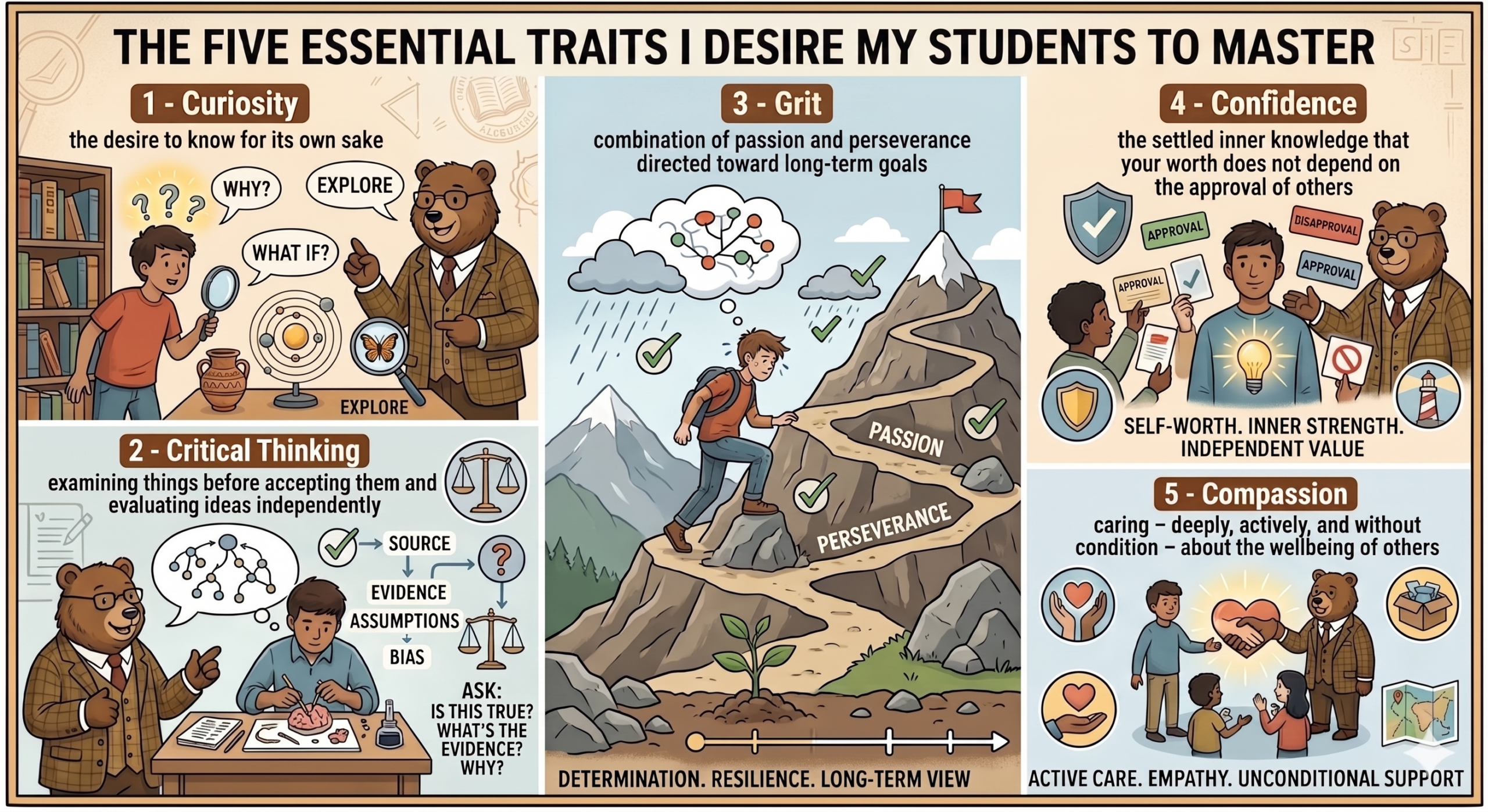
These are the five I return to most often. They are not the only ones that matter, but they are the ones I believe form the foundation upon which all others are built.
1 – Curiosity
Of all the traits a student can possess, curiosity may be the most generative – and the most undervalued by the systems that claim to cultivate it. We test for knowledge. We reward correct answers. We design curricula that move in straight lines from objective to assessment. And in doing so, we often extinguish the very quality that makes learning possible in the first place: the desire to know for its own sake.
I want my students to fall in love with knowledge – not in the narrow, credentialed sense, but in the wide-eyed, uncontainable sense that the developmental psychologist Jean Piaget described when he observed children at play, constructing and reconstructing their understanding of the world with a seriousness and intensity that puts most adult learners to shame. I want them to care about the composition of distant stars and the history of the street they walk down every morning. I want them to ask questions that have no obvious payoff, to read outside their discipline, to listen to people whose lives look nothing like their own.
There is a utilitarian case for broad knowledge, of course. The person who reads widely makes connections that specialists miss. The thinker who wanders across fields often stumbles onto ideas that the specialist, fixed in a single furrow, never encounters. The economist Joseph Schumpeter understood this when he described the process of creative destruction – the way innovation disrupts established industries – because genuine innovation almost always comes from the periphery, from the people curious enough to look where convention says not to bother.
But the deeper reason to cultivate curiosity is that it makes life richer. The curious person is never truly bored. The world remains, for them, inexhaustible.
And here I must emphasize something that too many students misunderstand: knowledge is not found only in classrooms. The lecture hall and the library are important, but they represent a fraction of the education available to anyone willing to pay attention. Knowledge lives in experiences – in travel, in work, in the quiet observation of how things actually function when you step outside the pages of a textbook. It lives in solitary reflection, in the hours spent thinking through a problem on a long walk or sitting with a difficult book that no one assigned. But more importantly, it lives in experiences shared with others. A conversation with someone whose background, beliefs, or worldview differs from your own can teach you more in thirty minutes than a semester of reading about diversity in the abstract. Vygotsky’s great insight – that cognitive development is fundamentally a social process, that we learn to think by thinking with and through other people – has been confirmed again and again by the sociological research on learning communities. Understanding is deepened, challenged, and refined through dialogue, through collaboration, through the friction and warmth of genuine human exchange. The student who learns only alone learns only half of what is available.
But curiosity alone is not enough. The curious student must also become a student of learning itself – of the process by which knowledge moves from fleeting encounter to durable understanding. This is a subject I feel strongly about, because too many bright, motivated learners spend years studying inefficiently, relying on habits that feel productive but produce little lasting retention: rereading highlighted passages, cramming before exams, passively reviewing notes. They mistake familiarity for mastery.
The cognitive science of learning has made extraordinary progress in identifying what actually works, and the findings are both counterintuitive and empowering. Retrieval practice – the act of pulling information from memory rather than passively re-exposing yourself to it – is among the most robust findings in the field, supported by over a century of research stretching back to the psychologist Hermann Ebbinghaus and his pioneering studies on the forgetting curve. Spaced repetition, in which study sessions are distributed across time rather than massed together, dramatically improves long-term retention by exploiting the way memory consolidation actually works at the neurological level. Interleaving, the practice of mixing different types of problems or subjects within a single study session, strengthens the ability to discriminate between concepts and apply knowledge flexibly – a capacity that transfer-of-learning research has shown to be critically important in the workplace, where problems rarely arrive neatly sorted by category.
Perhaps most importantly, the research shows that learning which feels effortful and even slightly uncomfortable is often the learning that sticks. The fluency we experience when rereading a familiar passage is seductive but largely illusory; it is the struggle of active recall, of testing yourself before you feel ready, that builds the neural architecture of lasting knowledge. I want my students to understand these principles not as study tips but as a fundamental reorientation in how they approach the acquisition of anything worth knowing. The curious mind deserves an efficient method. Without one, even the most passionate learner wastes enormous amounts of time and energy, and the frustration of forgetting what you once knew can, over time, erode the very curiosity that drove you to learn in the first place.
What I most want is for my students to understand that learning is not something that happens inside an institution and then stops. It is a commitment – quiet, personal, and lifelong. The diploma is not a finish line. It is, if anything, a starting gate. And the students who understand this – who carry their curiosity forward into every job, every relationship, every encounter with the unfamiliar – are the ones who will still be growing at sixty, at seventy, long after their peers have settled into the comfortable but diminishing routines of the already-known.
2 – Critical Thinking
If curiosity is the engine, critical thinking is the steering. Without it, even the most enthusiastic learner is at the mercy of whatever ideas happen to come along first. I want my students to possess a healthy, persistent doubt – not the cynical kind that rejects everything, but the constructive kind that insists on examining things before accepting them. In a world saturated with information, much of it algorithmically curated to confirm what we already believe, this capacity has never been more essential.
This begins with a deceptively difficult practice: understanding another person’s point of view before insisting on being understood yourself. It is remarkable how rarely this happens, even among educated people. We are so eager to make our case that we skip the harder work of genuinely hearing the opposing one. Yet it is precisely this discipline – the willingness to sit with an unfamiliar argument, to engage with it charitably and on its own terms rather than dismissing it prematurely – that separates rigorous thinking from mere opinion. The psychologist Jonathan Haidt has demonstrated how readily we construct post-hoc rationalizations for positions we arrived at emotionally, how the reasoning mind so often functions not as a judge weighing evidence but as a lawyer building a case for a verdict already reached. The cognitive biases that Daniel Kahneman and Amos Tversky spent decades cataloging – confirmation bias, anchoring, the availability heuristic – are not flaws that education automatically corrects. They are deep features of human cognition that require deliberate, sustained training to counteract.
The antidote is not to suppress emotion but to cultivate the habit of asking, with real sincerity, whether the person across from you might be seeing something you have missed.
I also want my students to learn the art of evaluating ideas independently. We all arrive in the classroom carrying the inherited assumptions of our families, our communities, our cultures. Some of those assumptions are sound. But many are not. The critically minded student learns to examine them without defensiveness, to ask not just “What do I believe?” but “Why do I believe it? And what would it take to change my mind?” That last question, honestly answered, is one of the most powerful tools a thinker can wield. The sociologist Peter Berger wrote about the “de-familiarization” that a true education produces – the unsettling but ultimately liberating experience of seeing your own conventions as contingent rather than inevitable. Emile Durkheim understood, more than a century ago, that much of what we take to be individual conviction is in fact the internalized pressure of social norms. The student who learns to distinguish between the two – between what they have chosen to believe and what they have merely absorbed – has gained a form of intellectual freedom that nothing can take from them.
This is not comfortable work. It can feel like losing your footing. But it is essential, and the students who learn to do it are the ones best prepared for a world that will not wait for them to catch up.
3 – Grit
Talent is real, but it is also wildly overrated. I have watched brilliant students flame out because they had never learned to endure difficulty, and I have watched average students accomplish extraordinary things because they simply refused to quit. The difference, almost always, comes down to grit – and I use the word deliberately, in the specific sense that Angela Duckworth has defined it: the combination of passion and perseverance directed toward long-term goals.
Grit is persistence for the long haul – not the feverish intensity that burns bright for a week and then vanishes, but the steady, unglamorous commitment that shows up on the days when showing up is hard. It is built on a foundational belief: that you can improve. This sounds obvious, but it is not universally held. Many students carry, often unconsciously, the conviction that their abilities are fixed – that they are either “good at math” or they are not, that they either have talent or they don’t. Dweck’s research on growth mindset has shown how profoundly this implicit theory of intelligence shapes performance. In study after study, students who believe ability is malleable outperform those of equal aptitude who believe it is fixed – not because belief is magic, but because belief shapes behavior. The student who thinks they can improve seeks challenge, embraces feedback, and persists through confusion. The student who thinks they cannot avoids all three.
One of the most important things I can do as a teacher is challenge the fixed-ability conviction wherever I encounter it. Ability is not static. It grows with effort, with practice, with intelligent failure.
But I want to press deeper than the popular understanding of grit, because there is a dimension of it that often goes unexamined and that connects directly to the economic concept of human capital formation. Grit is not only about the dramatic moments of perseverance – the study sessions almost every day and night, the athlete who plays through injury, the entrepreneur who rebuilds after bankruptcy. It is built, far more often, on the accumulation of small, daily decisions. It is the product of what psychologists call self-regulation and what economists frame as the weighing of opportunity costs – the recognition, conscious or intuitive, that every choice to pursue immediate gratification is simultaneously a choice to forgo future benefit.
Every day, a student faces dozens of quiet choices: study now or scroll later, attend office hours or sleep in, engage with a difficult reading or settle for the summary. None of these decisions feels momentous in the moment. But they compound. The economist Gary Becker demonstrated that human capital – the skills, knowledge, and capacities that determine a person’s productive value – is built through precisely this kind of sustained, voluntary investment. The student who consistently chooses the harder, more effortful path – not out of grim obligation, but out of a clear-eyed understanding that short-term comfort often comes at the expense of long-term growth – is exercising the very capacity that underlies grit.
Self-control, in this sense, is not the opposite of freedom. It is the precondition for it. The person who cannot regulate their own impulses is not free; they are merely reactive. Grit is what happens when self-control becomes habitual, when the daily discipline of choosing well accumulates into something durable enough to sustain a person through genuine adversity.
And failure is the word that matters most here. Every meaningful pursuit involves it. The question is never whether you will fail but how you will respond when you do. The developmental literature is clear on this point: resilience is not an innate trait that some people have and others lack. It is a capacity that is built through exposure to manageable difficulty, through the experience of falling down and discovering that you can stand back up. The gritty student treats failure not as a verdict but as information. They adjust, they try again, and they keep going. Over time, this habit of persistence becomes something close to a superpower – not because it guarantees success, but because it makes the person who possesses it almost impossible to defeat permanently.
4 – Confidence
Confidence is a quieter virtue than it first appears. It is not arrogance, not bravado, not the loudest voice in the room. True confidence is the settled inner knowledge that your worth does not depend on the approval of others. It is the refusal to live your life in fear of judgment. The psychologist Albert Bandura spent decades studying what he called self-efficacy – the belief in one’s capacity to execute the behaviors necessary to produce specific outcomes – and his research demonstrated something that every teacher senses intuitively: that what a person believes they can do is often a better predictor of what they will accomplish than what they can actually do. Confidence is not a luxury. It is a precondition for action.
I have seen too many talented students hold themselves back – not because they lacked ability, but because they were afraid. Afraid of looking foolish. Afraid of being wrong in public. Afraid of standing out. I see it every semester, and it is one of the quiet heartbreaks of teaching: the student who clearly has something to contribute but will not raise a hand, will not speak up in discussion, will not risk the vulnerability of an original thought expressed aloud. They sit in silence, rehearsing their idea internally, editing and re-editing it for safety, and by the time they have convinced themselves it is safe to speak, the moment has passed. Someone bolder has filled the space, sometimes with something less considered, and the silent student has learned, once again, that their voice does not belong in the room.
The developmental psychologist Susan Harter has documented how fear of negative evaluation intensifies during the college years – precisely the period when the developmental task of identity formation, as Erik Erikson described it, demands that young people experiment with ideas, try on perspectives, and risk being wrong in front of others. Fear of judgment is one of the great silent killers of potential, and I want my students to recognize it for what it is: a cage they can choose to leave.
But confidence without its counterweight becomes something dangerous. It curdles into arrogance, into the closed-minded certainty that needs no input from others. This is why I teach confidence and humility as a pair – not as opposites, but as complements that exist in a dynamic, productive tension. The truly confident person does not need to dominate a conversation or prove they are the smartest person in the room. They are secure enough to say, “I don’t know.” They are secure enough to ask for help, secure enough to change their mind when presented with better evidence. Humility is not the absence of confidence; it is confidence mature enough to recognize its own limits.
The philosopher and educator Parker Palmer has written beautifully about how the best teachers and leaders hold a paradoxical space – simultaneously sure-footed and open, clear in their convictions yet genuinely curious about what they might be wrong about. The research on intellectual humility, a growing field in social psychology, confirms that people who combine high confidence with genuine openness to being wrong make better decisions, build stronger teams, and earn deeper trust than those who project certainty alone.
This is the balance I want for my students. I want them to stand tall and speak clearly, but I also want them to listen with the kind of generous attention that signals respect for the person across from them.
Confidence also has a physical dimension that is worth naming explicitly, because our students so often underestimate it. It lives in body language – in the way you hold yourself, in the willingness to make eye contact, in the simple act of smiling. The way we present ourselves in social interaction is not merely a reflection of how we feel but a force that shapes how we feel and how others respond to us. Confidence lives, too, in listening – which may seem paradoxical but is not. The confident person listens well because they are not anxiously rehearsing what to say next. They are secure enough to be fully present. And that presence, more than any display of expertise, is what draws people in and earns their trust.
5 – Compassion
I have saved this trait for last because I believe it is the most important. All the curiosity, critical thinking, grit, and confidence in the world mean very little if they are not oriented toward something larger than the self. Compassion is what gives the other virtues their direction. Without it, curiosity becomes mere acquisition, critical thinking becomes cleverness in the service of advantage, grit becomes ruthlessness, and confidence becomes the polished exterior of a hollow ambition.
The Dalai Lama has spent a lifetime articulating a deceptively simple idea: that love and compassion are not luxuries but necessities – not ornaments added to a life already constructed, but the very foundation upon which a meaningful life must be built. They are not soft qualities that belong only in personal relationships; they are essential to public life, to leadership, to any endeavor that involves other human beings – which is to say, every endeavor. The student who learns to see the world through another person’s eyes, who feels the weight of another person’s suffering as if it were partly their own, has learned something that no textbook can teach and no credential can certify. The developmental literature on prosocial behavior tells us that this capacity is not fixed at birth. It can be cultivated. It can be practiced. And like a muscle, it grows stronger with use.
I am aware that this position invites a familiar objection, particularly from those steeped in the logic of markets and the orthodoxies of certain business schools. The argument runs as follows: the purpose of a corporation is to maximize shareholder value, full stop. Compassion is a private virtue, perhaps admirable in a person but irrelevant – even counterproductive – in a business context. Milton Friedman made this case forcefully in his 1970 essay for the New York Times, and its influence persists in boardrooms and business schools to this day, often repeated as though it were an economic law rather than a philosophical position.
But this objection rests on a fundamental misreading of the very intellectual tradition it claims to represent. Adam Smith, the thinker most often invoked as the patron saint of free-market capitalism, was first and foremost a moral philosopher. Before he wrote The Wealth of Nations in 1776, he wrote The Theory of Moral Sentiments in 1759 – and he considered it the more important work. In it, he argued that the capacity for sympathy – the ability to imaginatively enter into the feelings of another person – is the foundation of all moral judgment and, by extension, of a functioning society. Smith did not see self-interest and moral concern as opposing forces. He understood them as complementary, held in balance by what he called the “impartial spectator” – an internalized sense of fairness and propriety that restrains pure self-interest and makes cooperative enterprise possible.
Smith understood something that his later disciples have conveniently forgotten: that markets depend on trust, and trust depends on the perception that the parties involved care about something beyond their own enrichment. A seller who is indifferent to the quality of what they sell, who views the customer as nothing more than a source of revenue to be extracted, is not practicing capitalism in any sense that Smith would recognize. They are practicing something closer to what Smith himself would have called a vice: greed.
The economic evidence increasingly supports this claim. Research on organizational behavior consistently shows that companies with strong ethical cultures outperform their peers over the long term – in employee retention, in customer loyalty, in the capacity to attract the kind of talent that drives innovation. The students I send into the workforce will encounter the Friedman doctrine. Some of them will be pressured to adopt it. I want them to have the intellectual resources to recognize it for what it is, and the moral courage to insist on something better.
The most enduring businesses – the ones that build genuine loyalty and weather downturns and attract talent that stays – are almost invariably led by people who understand that compassion and profitability are not at odds. They are, in the long run, inseparable.
Compassion does not mean weakness. It does not mean agreeing with everyone or avoiding hard truths. It means caring – deeply, actively, and without condition – about the wellbeing of others. It means choosing kindness when indifference would be easier. It means remembering, in every interaction, that the person across from you is carrying struggles you may know nothing about. And it means building the kind of organizations, communities, and institutions where that recognition is not a platitude on a wall but a lived and daily practice.
In Conclusion
These five traits – curiosity, critical thinking, grit, confidence, and compassion – are not items on a syllabus. They cannot be tested with a multiple-choice exam or reduced to a letter grade. They are cultivated slowly, through experience, through example, and through the kind of patient mentorship that rarely makes headlines but that quietly shapes the trajectory of a life. The research tells us what good instructors have always sensed: that education, at its best, is a process of formation, not merely information.
We live in an era of rapid, disorienting technological change – arguably the most profound since the Industrial Revolution reshaped the economies of the West two centuries ago. Artificial intelligence is not merely automating routine tasks; it is beginning to encroach on cognitive work that we long assumed was the exclusive province of the human mind. Large language models can draft legal briefs, generate code, summarize research, and pass professional licensing exams. Robotic process automation is eliminating roles that seemed permanent a decade ago. The half-life of technical skills grows shorter with each passing year; some estimates suggest that a given technical competency now remains relevant for fewer than five years before it must be updated or replaced entirely.
In such a world, it is tempting to chase the newest tool, the latest platform, the most marketable credential – to treat education as a perpetual scramble to stay current with machines that will always be faster. While it is important to stay current, and to provide our students with the tools needed to succeed, we must never lose sight of the true foundations for success – for our students in their careers, and in their lives.
The students who will thrive in the decades ahead are not the ones who mastered today’s software. They are the ones who learned how to learn, how to think with rigor and independence, how to persevere when the path is unclear, how to lead with both conviction and humility, and how to treat other human beings with decency and care.
These are not soft skills. They are not supplementary. They are the most durable advantages a person can possess – precisely because they are uniquely, irreducibly human. No algorithm will replicate the genuine curiosity that drives a person to ask a question no one has thought to ask. No machine will exercise the moral courage to challenge an unjust policy at personal cost. No system, however sophisticated, will offer the kind of compassion that one human being can extend to another in a moment of real need – the hand on the shoulder, the willingness to sit in silence with someone else’s pain, the simple act of seeing another person fully and refusing to look away.
These are the traits that cannot be automated, cannot be outsourced, and cannot be rendered obsolete by the next wave of technological disruption. If my students leave with these qualities firmly rooted in their character, they will have what they need – not just for the workplace that awaits them, but for the long, unpredictable, deeply human lives they are only beginning to build.