
In an era of rising tuition costs and mounting student debt, the question of whether college is “worth it” has become a common debate across America. While critics point to successful entrepreneurs who dropped out or skilled tradespeople earning solid incomes without degrees, this narrative misses a crucial dimension of what return on investment truly means when it comes to higher education.
The Baseline Reality
Yes, it is entirely possible to earn a living without a college degree. Retail supervisors, administrative assistants, delivery drivers, and customer service representatives can all maintain households and pay their bills. Many of these positions offer honest work at respectable wages, often in the $37,000 to $47,000 range as of early 2026. For those willing to work multiple jobs or put in overtime, the numbers can stretch higher.
But here is what often goes unspoken: the BLS Consumer Expenditure Survey puts average annual household spending at $78,535 in 2024 — with housing running $26,266, transportation $13,318, food $10,169, and healthcare $6,204, those four categories alone totaling more than $55,000.1 A worker earning the median wage for these occupations takes home somewhere between $30,000 and $38,000 after taxes. The gap between those two numbers is not a budgeting problem. It is a structural one – beyond the constant vigilance required to simply survive, one unexpected car repair or medical bill can trigger a cascade of financial stress. These jobs provide subsistence, but rarely abundance.
The skilled trades represent a notable exception. Electricians, plumbers, and HVAC technicians can command impressive salaries, often exceeding those of many college graduates – median salaries range in $59,000 to $62,000 with the top salaries reaching into six figures. While apprenticeships are paid and technical training degrees may be shorter than traditional college ones, these paths present their own challenges: the physical demands can limit long-term career longevity. HVAC technicians in particular carry one of the highest rates of injury and illness of all occupations, according to the Bureau of Labor Statistics, and physical wear across all three trades is substantial, and physical wear can force career transitions at a time when retraining options are limited.
The Multiplier Effect of Education
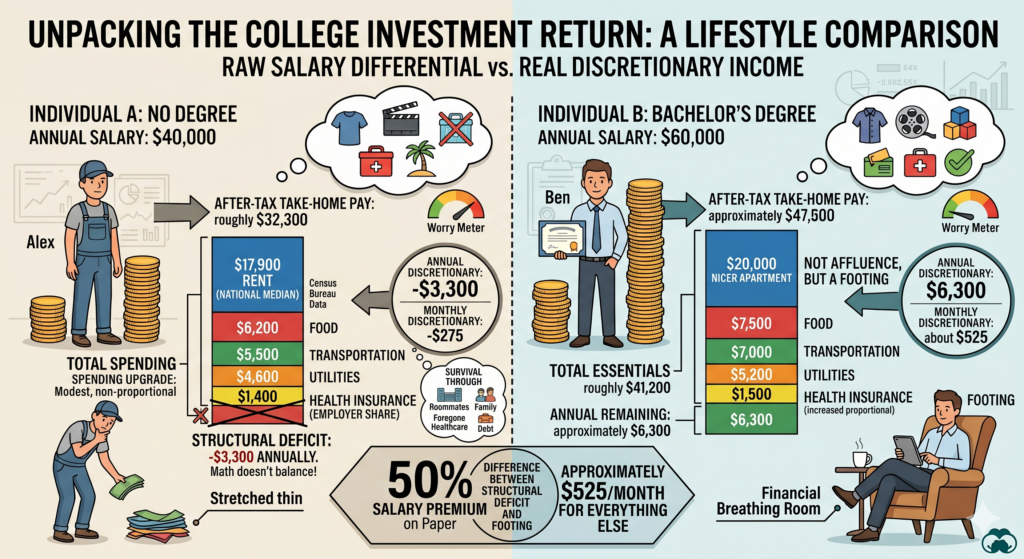
When we examine the return on college investment, the raw salary differential tells only part of the story. Consider two individuals: one earning $40,000 annually without a degree, another earning $60,000 with a bachelor’s degree.2 On paper, that’s a 50% salary premium. In reality, it’s the difference between two entirely different ways of life.
At $40,000, after federal income tax, FICA, and average state income tax, you take home roughly $32,300. Now subtract $17,900 for rent at the national median — $1,487 per month, according to Census Bureau data — $6,200 for food, $5,500 for modest transportation, $4,600 for utilities, and $1,400 for your share of employer-sponsored health insurance. Those five categories alone total $35,600. You are now spending $3,300 more than you take home. Before clothing, before savings, before a single emergency, the math doesn’t balance. Many people at this income level survive through gig work, coupons and other savings strategies, roommates, family support, foregone healthcare, or debt — not through budgeting discipline.
At $60,000, after the same taxes, take-home pay is approximately $47,500. Upgrade to a somewhat nicer apartment at $20,000 annually, increase food spending to $7,500, transportation to $7,000, utilities to $5,200, and health insurance to $1,500, and your total essential spending reaches roughly $41,200 — leaving approximately $6,300 annually, or about $525 per month for discretionary spending, savings, and emergencies. That is not affluence. But it is the difference between a structural deficit and actual financial ground to stand on.
This isn’t just three times more discretionary income — it is the difference between a budget that cannot close and one that can.
The Compound Benefits
This financial cushion creates cascading advantages that compound over time. With discretionary income, college graduates can afford to take calculated risks – accepting an initially lower-paying job with better long-term prospects, relocating for opportunities, or investing in additional certifications and skills. They can attend conferences, join professional organizations, and build networks that further accelerate career growth.
Moreover, many college-educated positions offer benefits that don’t appear in salary figures but dramatically impact quality of life. Comprehensive health insurance, retirement matching, flexible work arrangements, and professional development budgets are standard in many degree-requiring fields but rare in positions without educational requirements. Savings for retirement may often substantially increase – with earlier achievement of “financial freedom” now far more likely.
The geographic and professional mobility that comes with a degree cannot be overstated. A marketing professional can work in Seattle’s tech scene, Manhattan’s media world, or remotely from a cabin in Montana. A retail manager’s opportunities are largely confined to where stores need staffing.
Beyond the Material – Life Enrichment
Perhaps most significantly, the return on college investment extends far beyond financial metrics. Higher education, at its best, develops critical thinking, communication skills, and cultural literacy that enrich life in immeasurable ways. The confidence to navigate complex systems, evaluate information critically, and adapt to changing circumstances becomes invaluable in a rapidly evolving economy.
College graduates report higher job satisfaction, better health outcomes, and greater civic engagement. They are more likely to have jobs with intellectual stimulation and creative problem-solving. While these benefits resist easy quantification, they profoundly impact daily happiness and life satisfaction.
The Real Calculation
When evaluating college’s return on investment, we must look beyond simple salary comparisons. The question is not just whether you’ll earn more, but whether you will earn enough more to transcend paycheck-to-paycheck existence. It’s about accessing careers with growth trajectories rather than ceiling limits. It is about having choices – where to live, how to spend your time, and what risks to take.
The true return on college investment cannot be measured in dollars alone, but in opportunities, security, a greater understanding of the world and greater appreciation for its treasures, and the freedom to shape your own path. For many, that return proves invaluable.
Footnotes
- U.S. Bureau of Labor Statistics. Consumer Expenditures — 2024. December 19, 2025. https://www.bls.gov/news.release/cesan.htm ↩︎
- BLS Consumer Expenditure Survey 2024; Census Bureau American Community Survey 2024 (median gross rent); KFF 2025 Employer Health Benefits Survey (employee single-coverage contribution: $1,440–$1,492 annually); IRS 2024 tax brackets. ↩︎