
As I explored last week, higher education stands at an inflection point. The demographic reality of the enrollment cliff – a projected 15% decline in traditional college-age students beginning in 2026 – combines with decades of declining state and federal support for higher education and mounting pressure to contain tuition increases. Meanwhile, employers increasingly question whether our graduates possess the critical thinking, communication, and adaptive capabilities the modern workplace demands. These challenges are formidable, but they also present an opportunity to fundamentally rethink how we educate the next generation of business leaders.
The Limits of the Industrial Model
For over a century, American higher education has operated on what I call the “industrial model” – lecture halls (both large and small), standardized content delivery, time-bound progression, and economies of scale that prioritize efficiency over effectiveness. This model served us well when the goal was democratizing access to knowledge and producing graduates for relatively stable career paths. But the world has changed profoundly.
The half-life of business knowledge has shortened. Artificial intelligence is transforming every sector of the economy, including entry-level professional work. Employers don’t just need graduates who know financial ratios or marketing frameworks – they need adaptive thinkers who can synthesize information, communicate persuasively, collaborate across differences, and navigate ambiguity with ethical judgment.
The traditional lecture-based model, while efficient at transmitting information, consistently fails to develop these higher-order competencies. We have known this for decades – educational research dating back to Benjamin Bloom in the 1980s demonstrated that personalized instruction and mastery-based learning produce dramatically better outcomes than conventional approaches.1 Yet the economic realities of higher education have made such personalization seem impossibly expensive. Until now.
The Convergence of Ancient Wisdom and Modern Technology
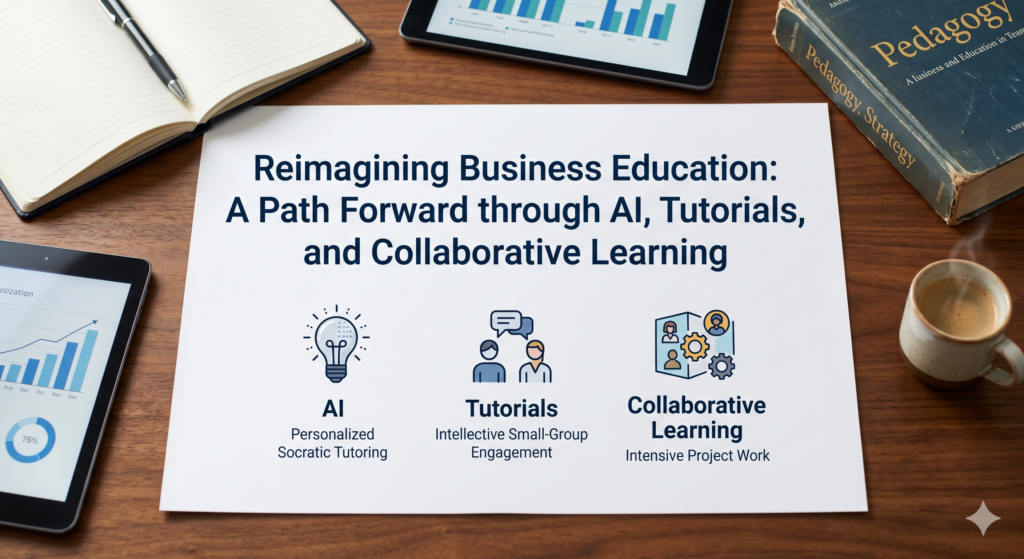
Over the past year, I’ve been developing a transformative model for business education that synthesizes three powerful elements: AI-powered adaptive learning, the centuries-old Oxbridge tutorial method, and intensive collaborative project work. This approach isn’t merely incremental improvement – it is a fundamental reconceptualization of what’s possible when we combine the best of pedagogical tradition with cutting-edge technology.
Part 1 – AI as Personalized Tutor
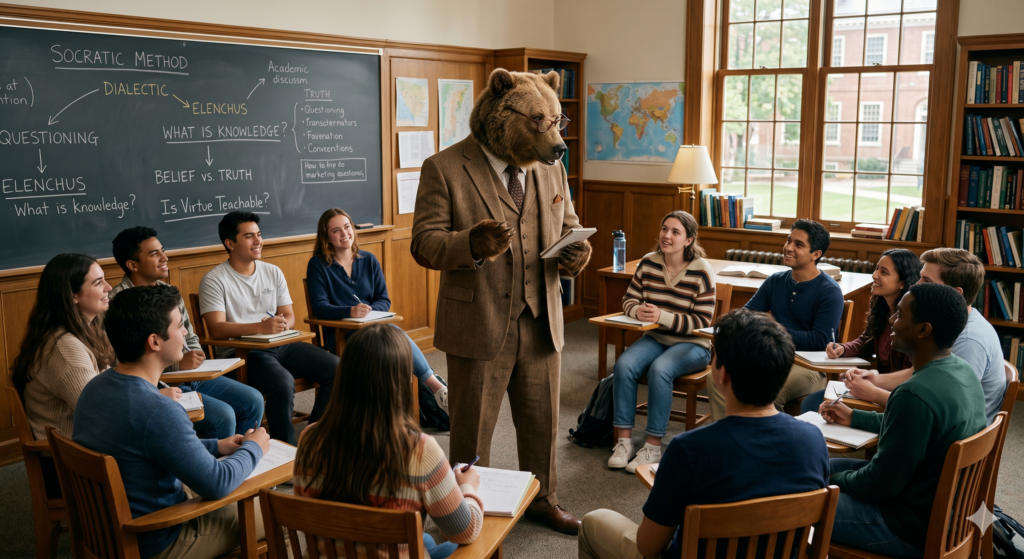
The first pillar leverages intelligent tutoring systems that provide each student with a personalized learning journey. Modern AI tutors don’t simply deliver content – they engage students through Socratic questioning, adapt to individual learning styles and paces, provide immediate formative feedback, and ensure mastery before progression to more complex concepts.
Research on the effectiveness of AI tutoring systems has now accumulated across three decades, and the findings are striking in their consistency. A 2016 meta-analysis found that properly implemented intelligent tutoring systems raised student test scores a median of 0.66 standard deviations above conventional instruction — the equivalent of moving a student from the 50th to the 75th percentile — with students in AI-tutored conditions outperforming conventional instruction in 92% of studies. That finding has since been confirmed at scale: a 2026 second-order meta-analysis, synthesizing 19 separate meta-analyses covering nearly 59,000 participants and primary studies spanning 1993 to 2024, found a mean effect size of 0.67 – transforming a C+ student to a B+ student.2 More importantly, AI tutors are available 24/7, can serve unlimited students simultaneously, and generate detailed analytics that help faculty identify exactly where students struggle.
This addresses one of higher education’s fundamental economic challenges: How do we provide personalized attention at scale? AI tutors handle foundational knowledge building – definitions, procedures, calculations, basic applications – freeing faculty time for what humans do best.
Part 2 – Oxbridge Tutorials: The Gold Standard Reimagined
The second pillar draws from Oxford and Cambridge’s tutorial system – arguably the most effective pedagogical method ever devised for developing critical thinking and intellectual confidence. In traditional Oxbridge tutorials, 2-4 students meet periodically (weekly or biweekly) with an expert tutor to discuss essays they’ve written, defending their arguments under Socratic questioning and rigorous intellectual challenge.
This method works because it demands deep engagement. Students can’t hide in the back of a lecture hall. They must articulate ideas, defend reasoning, respond to challenges, and learn from peer perspectives. The intellectual intimacy of small-group discussion develops not just knowledge but judgment, confidence, and communication skills – exactly what employers seek.
The challenge has always been scalability. How can we provide weekly tutorial sessions to every student without unsustainable faculty workloads?
This is where AI integration becomes transformative. By handling foundational instruction, AI frees faculty to focus entirely on facilitating tutorials. A professor who no longer lectures can conduct multiple tutorial sessions weekly, providing intensive mentorship to a cohort of students – a manageable teaching load that delivers Oxford-quality education at public university scale.
Part 3 – Collaborative Projects: Learning by Doing
The third pillar emphasizes team-based projects, workshops, and presentations that mirror professional practice. Business is fundamentally collaborative – professionals work in teams, present to stakeholders, negotiate across differences, and produce work products together. Yet traditional business education often remains stubbornly individualistic.
By integrating extensive team projects throughout the curriculum – case analyses, business plans, financial models, client presentations – students develop the collaboration and communication skills employers value most. When combined with AI-guided preparation and tutorial-based reflection, project work becomes a powerful vehicle for developing both technical competence and professional judgment.
Why This Model Addresses Today’s Challenges
This integrated approach directly addresses the existential challenges facing higher education:
- Financial Sustainability: AI automation reduces the faculty time required for routine instruction, assessment, and feedback. This doesn’t eliminate faculty – it redirects their expertise toward high-value mentoring and facilitation that AI can’t replicate. We achieve personalization at scale without proportional cost increases.
- Student Recruitment and Retention: In an increasingly competitive market, distinctive pedagogy becomes a powerful differentiator. “Oxford-style tutorials plus AI-personalized learning” is a compelling value proposition for prospective students and families. The model’s emphasis on demonstrated mastery and intensive mentorship also improves retention – students who feel seen, supported, and challenged are less likely to drift away.
- Outcome Quality: The research evidence is clear – this combination of personalized adaptive learning, small-group Socratic dialogue, and collaborative practice can produce better learning outcomes than conventional instruction. Better outcomes mean higher professional certification pass rates, stronger employment prospects, and graduates who thrive in practice – outcomes that attract students, satisfy employers, and justify continued investment in higher education.
- Equity and Access: Perhaps most importantly, this model has the potential to narrow achievement gaps. AI-powered mastery learning ensures struggling students receive additional support and time to achieve competence rather than being left behind. Tutorial-based mentorship provides intensive attention to students who might otherwise feel anonymous in large lectures. We can make elite pedagogy accessible to first-generation students, working students, and those from under-resourced backgrounds.
One Path Among Many
I want to be clear: this integrated model is not the solution to higher education’s challenges – it is a solution worth exploring. Different institutions, disciplines, and student populations may require different approaches. Some fields may benefit more from experiential learning or apprenticeship models. Some institutions may find different technologies or pedagogical frameworks better suited to their missions and contexts.
What matters is that we are willing to experiment, assess rigorously, and learn from both successes and failures. The worst response to our current challenges would be defensive traditionalism – clinging to familiar methods simply because they’re familiar, even when evidence suggests better alternatives exist.
We need many experiments, many innovations, many attempts to reimagine what higher education can be. This proposal represents a contribution to that broader conversation, informed by research into AI in education, years of instruction, and deep engagement with the professional fields we serve.
Reason for Optimism
Despite the very real challenges we face, I’m optimistic about higher education’s future – not because the path forward is easy, but because the imperative for innovation has never been clearer, and the tools available have never been more powerful.
We stand at a remarkable moment. For the first time in history, technology enables truly personalized education at scale. We can combine the wisdom of centuries-old pedagogical traditions with the power of modern artificial intelligence. We can maintain the human connection and mentorship that makes education transformative while leveraging automation to make that connection economically sustainable.
More importantly, thoughtful implementation of these innovations can produce graduates who are genuinely better prepared for the rapidly evolving world they’ll inherit. Business students who have spent four years engaging in Socratic dialogue, defending arguments, collaborating on complex projects, and developing mastery through personalized feedback will not merely survive in an AI-augmented workplace – they’ll thrive. They’ll possess the critical thinking, adaptive expertise, ethical reasoning, and communication skills that no algorithm can replicate.
The enrollment cliff, declining government support, and pressure on tuition are real constraints. But constraints often drive creativity. The institutions that will flourish in the coming decades won’t be those with the largest endowments or most prestigious brands – they will be those willing to fundamentally rethink their educational models, measure outcomes rigorously, and put student success genuinely at the center of their mission.
We can do this. We can address the financial challenges through smart integration of technology and human expertise. We can attract students through distinctive, demonstrably effective pedagogy. We can satisfy employers and communities by producing graduates who are truly prepared for professional success. And we can uphold our democratic mission by making world-class education accessible to students from all backgrounds.
The question is not whether higher education can navigate the challenges ahead – it’s whether we have the courage and creativity to embrace transformation. Based on what I’ve learned from educators, students, and industry partners over the past year, I believe we do.
The future of business education – and perhaps higher education more broadly – won’t look like the past. That’s not something to fear. It’s something to help build.
Ron A. Rhoades serves as Co-Director of the Cerity Partners Personal Financial Planning Program within the Department of Finance, Gordon Ford College of Business, Western Kentucky University. This article represents his own personal views, and are not necessarily the views of any institution, firm, company, organization, cult, gang or motley crew with whom he has ever been associated or been kicked out of.
Footnotes
- Bloom, Benjamin S. “The 2 Sigma Problem: The Search for Methods of Group Instruction as Effective as One-to-One Tutoring.” Educational Researcher, vol. 13, no. 6, 1984, pp. 4–16. ↩︎
- Kulik, J.A., & Fletcher, J.D. (2016). “Effectiveness of Intelligent Tutoring Systems: A Meta-Analytic Review.” Review of Educational Research, 86(1), 42–78; Ünal, E., Kaya, M., Uzun, A.M., & Erdem, C. (2026). “A Second-Order Meta-Analysis on the Effects of Artificial Intelligence Applications on Student Outcomes.” Journal of Educational Computing Research. https://journals.sagepub.com/doi/10.1177/07356331261424767 ↩︎